
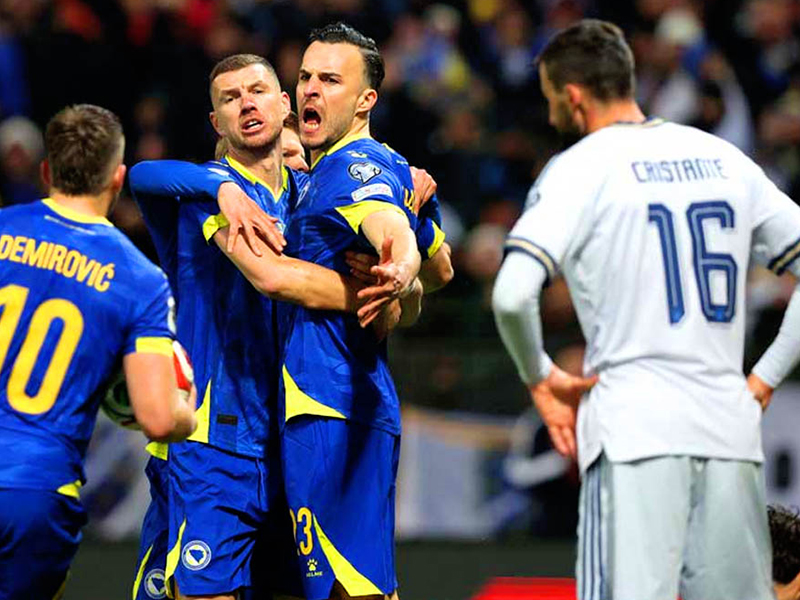
Four-time champions Italy’s national football team suffered another major setback, missing out on a third consecutive World Cup after losing on penalties to Bosnia and Herzegovina’s national football team. Having already failed to qualify for the 2018 FIFA World Cup and the 2022 FIFA World Cup, this latest collapse marks an unprecedented run for a former winner of the competition.
Missed spot-kicks from Pio Esposito and Bryan Cristante proved decisive after a tense encounter in which Gennaro Gattuso’s side had battled with 10 men to force penalties. Bosnia held their nerve, converting all four of their attempts to secure qualification.
For Bosnia, it is only their second appearance at the tournament, with 40-year-old captain Edin Dzeko playing a key role in their success. They now head into a group alongside Canada national football team, Qatar national football team and Switzerland national football team.
Red card, pressure and late equaliser
Italy had taken the lead early when Moise Kean finished from distance after Nicolo Barella capitalised on a mistake by goalkeeper Nikola Vasilj. The advantage, however, was short-lived in terms of control.
The match shifted dramatically before half-time when defender Alessandro Bastoni was sent off for bringing down Amar Memic while through on goal. Reduced to 10 players, Italy were forced onto the defensive for much of the second half.
Goalkeeper Gianluigi Donnarumma produced several important saves, but Bosnia eventually broke through. After he parried a header from Dzeko, Haris Tabakovic reacted quickest to score the rebound and send the game into extra time, where the hosts maintained their composure and ultimately prevailed.
Emotional aftermath and uncertain future
The defeat left Italy’s camp devastated. Gattuso, visibly emotional, admitted the result was difficult to accept, stating he would have sacrificed greatly for qualification and insisting his own future was secondary. Federation president Gabriele Gravina urged him to remain in charge, while acknowledging the depth of the crisis.
Players also struggled to process the outcome. Leonardo Spinazzola described the disappointment as overwhelming, pointing to the team’s effort despite being a man down and the missed opportunities that might have changed the result.
This latest failure adds to a worrying trend. Since lifting the trophy in 2006, Italy have not progressed beyond the group stage in subsequent tournaments and now face a prolonged absence from the global stage, despite their triumph at UEFA Euro 2020.
Deeper issues behind the decline
Italy’s struggles extend beyond a single match. The current situation has roots in structural challenges within the domestic game. Following their 2006 success, built on a generation developed in earlier years, the talent pipeline has weakened.
Changes after the Bosman ruling allowed a surge of foreign players into Serie A, limiting opportunities for young domestic players. Observers have pointed to shortcomings in youth development and recruitment strategies as contributing factors.
Financial difficulties and outdated infrastructure have also played a role. Italian clubs lag behind Europe’s top earners, with limited revenue streams compared to leagues benefiting from lucrative broadcasting deals and investment. Stadium conditions and commercial limitations further restrict growth.
Former players and analysts have highlighted the need for reform across multiple areas, from youth systems to off-field management. Repeated qualification failures, including previous play-off defeats, have left a lasting psychological impact, with this latest setback reinforcing concerns about the direction of Italian football.