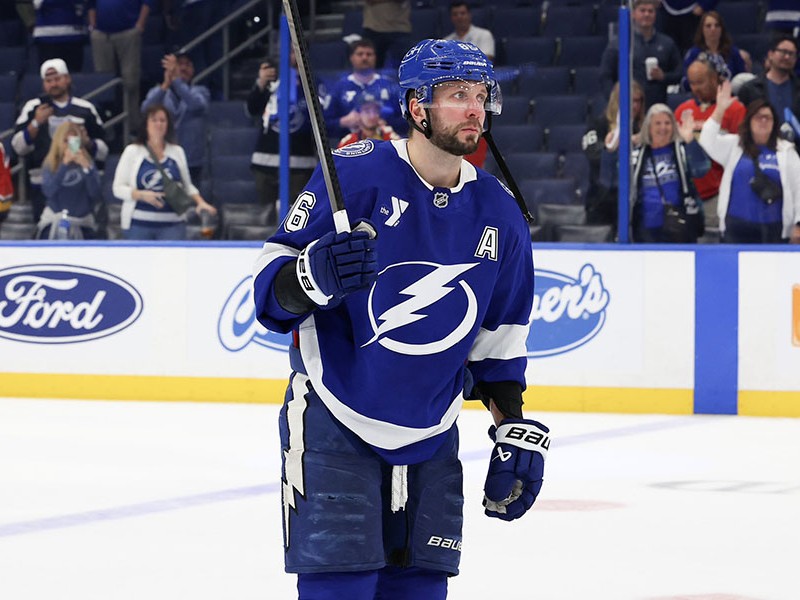
Nikita Kucherov has positioned himself perfectly for his next contract talks with the Tampa Bay Lightning. Following a 130-point season and his second Hart Trophy, the winger is now entering the final year of his current deal, which counts $9.5 million against the cap.
His 2025-26 season featured a remarkable 107 points over a 53-game stretch, with nine contests where he recorded at least four points. Kucherov was kept off the scoresheet in just 16 games throughout the entire year, which only adds to his argument for a significant pay increase.
The Lightning must now determine how much they are willing to offer. Recent contracts for Leo Carlsson, Macklin Celebrini, and Connor Bedard have shifted the financial landscape considerably, while Kucherov’s age introduces a separate set of concerns.
Market conditions complicate Kucherov’s extension
Carlsson and Celebrini are scheduled to earn nearly double Kucherov’s $9.5 million salary next season, and Bedard has secured a deal worth $15 million per year. While Kucherov can reasonably claim to be the superior player, those three are over a decade younger and still improving.
That leaves Tampa and Kucherov searching for a number that works for both sides. An $18 million annual figure, similar to what Carlsson and Celebrini received, would be tough to justify given Kucherov’s age. On the other hand, a modest raise of about $2 million would not reflect his output or the current market trends.
Leon Draisaitl provides a more realistic benchmark. He turns 31 in October and will earn $14 million per season over seven years. Kucherov has also registered 86 more points than Draisaitl across the last three seasons, giving him a solid case for a figure above $14 million.
Tampa does hold one potential edge. Florida’s absence of a state income tax has previously helped the Lightning secure favorable deals with players like Brayden Point and Brandon Hagel. That could soften Kucherov’s demands somewhat, though the current financial climate makes a major discount unlikely.
Contract length may matter as much as the money
Recent patterns suggest that maximum-term extensions following entry-level contracts are becoming less frequent. Carlsson, Celebrini, and Bedard all opted for five-year deals, which lets them return to the market while still young and potentially benefit from future cap increases.
Kucherov’s situation is entirely different. His next contract will start when he is 34, making a longer commitment especially appealing. Coming off a Hart Trophy campaign, this may be his best chance to lock in one last major deal before any decline in his play becomes evident.
For Tampa, however, agreeing to $13 million or $14 million per year over a long term would carry notable risk. The later years of such a contract could become problematic if Kucherov’s production falls off sharply in his late thirties.
There is also a theoretical path to an eight-year deal if Kucherov signs by September 16. That structure could reduce the annual salary while extending his commitment through age 41. Although that option may not appeal to the Lightning, added term could offer some roster flexibility if it lowers the yearly cost.
Roster makeup adds another layer of difficulty
The Lightning already have several key pieces secured for the foreseeable future. Point, Hagel, Jake Guentzel, Anthony Cirelli, Victor Hedman, and JJ Moser are all locked in, but additional financial pressures are looming.
Andrei Vasilevskiy has two seasons remaining on his contract, while Conor Geekie and Gage Goncalves could become candidates for notable extensions next summer if they take another step forward during the 2026-27 campaign.
Tampa also needs to strengthen a roster that has not advanced past the first round in four consecutive postseasons. The centre position remains an area where the team could use more depth, with Yanni Gourde and Dominic James currently behind Point and Cirelli.
The Lightning could also benefit from adding youth on defence. Hedman, Ryan McDonagh, and newly acquired John Carlson cannot be expected to contribute at a high level indefinitely, but bringing in more talent becomes harder if Tampa remains tight against the salary cap.
A rising cap should give the Lightning more room to work with in the coming seasons. Still, a massive Kucherov contract would eat up a large portion of that additional space.
Kucherov deal tests Tampa’s approach to contracts
Tampa has built a reputation for securing value in its agreements rather than routinely paying above market rates. Point and Hagel are examples of deals that have worked out well, and the absence of a $10 million player on the current roster shows how carefully the Lightning have managed their payroll.
That will change when Kucherov signs his next contract. He, Point, and Vasilevskiy currently carry matching $9.5 million salaries, raising the question of whether Tampa would be comfortable paying Kucherov $5 million more than those two if negotiations reach that level.
The team’s earlier decision regarding Steven Stamkos also offers an important reference point. Tampa ultimately moved on from its franchise icon after the two sides could not agree on a new deal.
Kucherov is producing at a far higher level than Stamkos was at that time, but the episode showed that the Lightning have a limit when it comes to negotiations. The challenge now is figuring out whether Kucherov’s exceptional production is enough to push that limit higher.