
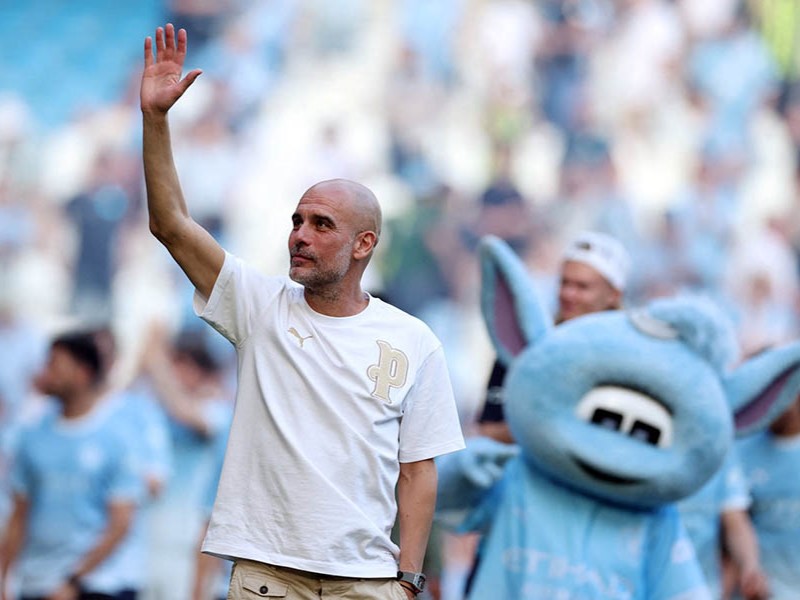
The Pep Guardiola era at Manchester City has finally come to an end. After 10 years leading one of the most dominant football teams that English football has ever seen, the Spaniard is taking off. The 2025/26 season was one of his more underwhelming ones, as the team started to show signs of decline. They dealt with injuries and winners’ fatigue, but Man City still dominated many aspects of the game using the man’s key tactical pillars of territorial dominance, positional control, relentless pressing, and tactical reinvention/evolution.
The aura weakened, however, because teams showed more confidence against them. He made the right decision to bow out while the ovation was loudest. He now leaves behind a legacy that is impossible to ignore or match.
Where Guardiola ranks among Premier League great managers
Even while he was there, he was constantly compared to the big three of Premier League football: Sir Alex Ferguson of Manchester United, Arsène Wenger of Arsenal, and José Mourinho of Chelsea. He would later encounter Mourinho at Man United, but the Portuguese manager would pose little threat. And then he had Jürgen Klopp at Liverpool, with whom he had epic battles for seven out of 10 years. All these managers transformed English football in different ways, but Guardiola’s case may ultimately be unmatched from a pure footballing perspective.
Ferguson lasted over two decades, which allowed him to properly build a dynasty of efficiency and impeccable man-management. Wenger, who Guardiola is more similar to, modernised English football culturally and tactically. Mourinho introduced elite pragmatism and psychological warfare. And Klopp, who he has called his greatest rival, revived emotional, high-intensity football.
The former Barcelona and Bayern Munich manager’s time was marked by drastic upgrades to the very fabric of Premier League football. Even more drastic than Wenger’s upgrades. His City side normalised 90-plus-point title races, inverted full-backs, hyper-positional structures and suffocating possession football. Soon, every team was trying to become another Manchester City in a bid to dominate the league like Guardiola, but none could actually pull it off.
He had the help of the club’s vast resources to do this, however, and herein lies the argument against his legacy. “Would he have been able to do all of this if Man City was just a ‘regular club’ without rich owners?’ was the topic of discussion year in, year out. Many ignored the fact that spending does not equal success to still push this narrative. Regardless of the chatter, Guardiola belongs firmly in the top tier of Premier League managers. Whether he ranks above Ferguson depends, widely accepted as the greatest for his longevity and exploits, largely on whether one values tactical revolution over said longevity.
What comes next for Manchester City and the Premier League?
Replacing Guardiola will not be easy. For Man City, it will not simply be about appointing another elite coach. It must be about succeeding a system that reshaped the club’s identity. If Enzo Maresca is eventually viewed as part of City’s long-term future, his challenge will not be to imitate Guardiola completely because blind imitation would only invite constant comparison. Instead, he would need to preserve City’s technical standards while building tactical ideas that feel distinctively his own.
For the Premier League, Guardiola’s exit could reopen competitive balance. No more pressure to be perfect because that is what it literally took to topple Guardiola. With him, 90-point title races are all but gone. Constant reinvention and evolution will slow down. The league may return to its frantic pace where games were chaotic and not controlled. However, his shadow will loom over them because the man has raised up many disciples. This is Guardiola’s true legacy, one that English football may never fully move on from. The Premier League will continue playing in the image he helped create.