
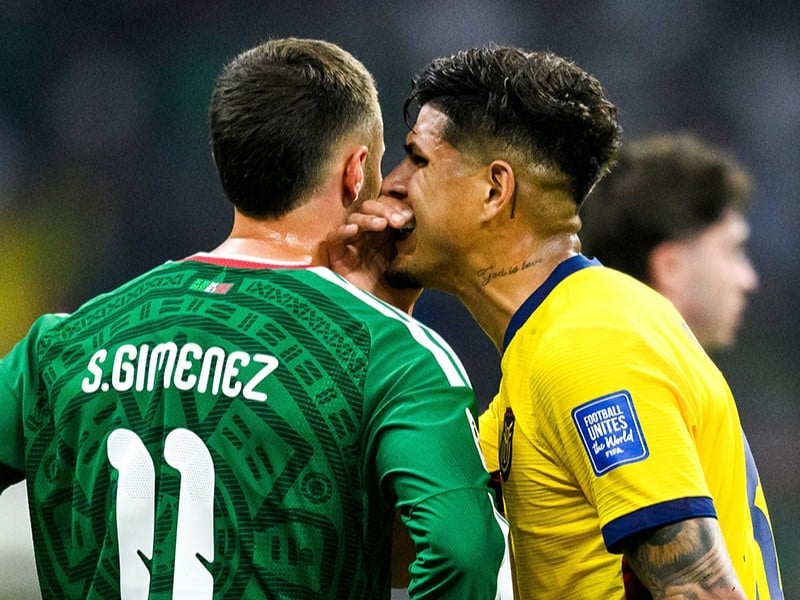
Ecuador defender Piero Hincapie was sent off during his team’s 2-0 defeat to Mexico after covering his mouth while speaking to an opposing player. The incident happened in stoppage time of the second half, with Ecuador already on course to be eliminated from the 2026 World Cup.
The 24-year-old Arsenal centre-back concealed his mouth while addressing Mexico forward Santiago Gimenez during a confrontation. Referee Slavko Vincic of Slovenia did not witness the exchange in real time, but after being alerted by the video assistant referee, he reviewed the footage on the pitchside monitor before issuing a red card.
The dismissal makes Hincapie the second player at the tournament to be sent off under FIFA’s newly introduced regulation concerning players covering their mouths during confrontational exchanges.
A new tournament rule claims another player
Earlier in the competition, Paraguay winger Miguel Almiron became the first footballer dismissed under the same rule. He received a red card during his country’s group-stage meeting with Turkey, although Paraguay still secured a 1-0 victory despite finishing the match with 10 men.
Not every incident involving a player hiding their mouth has resulted in a dismissal. England midfielder Jude Bellingham avoided a red card after covering his mouth while speaking with Ghana’s Jordan Ayew during a match played last week.
Before the World Cup began, Fifa’s head of referees, Pierluigi Collina, explained that players would only risk punishment when concealing their mouths during confrontational situations. He added that the restriction would not apply to conversations considered friendly.
Background behind the law change
The regulation was approved during a special meeting of the International Football Association Board held in Vancouver in April. The decision introduced a new approach to dealing with confrontations in which players deliberately obscure their lips while speaking.
FIFA president Gianni Infantino had previously expressed support for introducing such sanctions. He stated that match officials should begin from the assumption that a player who hides their mouth during an argument has likely said something inappropriate.
Despite the new guidance, the final decision on whether to issue a red card still rests with the referee, who is expected to assess every incident individually before taking disciplinary action.
Previous controversy highlighted the issue
The subject attracted attention in February during a Champions League fixture when Benfica winger Gianluca Prestianni pulled his shirt over his mouth while speaking to Real Madrid’s Vinicius Jr.
Prestianni was initially accused of racist abuse, an allegation he denied, and received a provisional one-match suspension. After completing its investigation, UEFA instead ruled that he had committed homophobic conduct and imposed a six-match ban, with three of those matches suspended.