
Cristiano Ronaldo’s time with the national team has reached a painful and surprising ending, closing a 23-year period during which he reshaped Portuguese football and became the country’s all-time leading scorer.
The 41-year-old confirmed his retirement following a dispute with coach Jorge Jesus, which led to a 30-day ban and a €255 fine. The sanction came after Ronaldo chose to leave Portugal’s training camp without authorization upon learning he would be removed from the starting eleven.
His last match was against Wales on 24 September. Ronaldo ends his international journey with 146 goals from 234 caps, leaving behind records and accomplishments that have elevated Portugal’s status in global football. While the nation has already started paying tribute to its legendary captain, the manner of his exit has created an uneasy atmosphere.
Cristiano Ronaldo’s Portugal farewell concludes amid controversy
Ronaldo’s departure was not entirely unavoidable. Jesus had maintained that the door remained open and that the final call belonged to the forward. Still, the possibility of losing his guaranteed starting spot seemed hard for the Portugal captain to accept.
There was a familiar sense of defiance in how he responded. Across his career, Ronaldo has found it difficult whenever coaches questioned his status or limited his role. Yet reducing his retirement to just another clash would ignore the profound transformation he brought about over more than two decades with the national side.
His connections with Portugal’s coaches were seldom simple. Some became significant figures in his life, while others dealt with the challenges of managing a player whose influence reached far beyond what he produced on the field.
When Ronaldo first entered the national team dressing room, he was an exceptionally gifted but immature young man. He wore his baseball cap backward, oversized sunglasses, and headphones so loud that others could hear them from a distance. Even around respected figures like Luis Figo and Rui Costa, he would not take off his cap during meals.
Luiz Felipe Scolari saw his remarkable talent but also realized that his attitude required adjustment. After publicly disciplining the youngster, the coach made him a private promise that he could one day become Portugal’s captain if he learned to conduct himself differently.
Euro 2004 devastation and the formation of a leader
Ronaldo’s first major international setback came when he was only 19. Portugal reached the Euro 2004 final on home ground, with the nation believing its first major international title was within grasp. Instead, Angelos Charisteas netted the only goal as Greece pulled off a shocking upset at the Estadio da Luz.
The teenager was unable to control his feelings after the final whistle. Pictures of him weeping on the pitch in Lisbon circulated around the globe, offering an early sign of how deeply representing Portugal mattered to him. That loss also gave Ronaldo a harsh lesson in the demands of playing in major finals.
At that point, Figo still wore Portugal’s number seven shirt, so Ronaldo had the number 17. The veteran winger helped him adjust to the squad but did not make his path easy. When Figo retired from international football in 2006, the shirt and the responsibility of leading the team were handed to Ronaldo.
Another pivotal moment in their relationship with Scolari occurred in September 2005. Before a World Cup qualifier in Russia, the coach and Figo went to Ronaldo’s room to tell him that his father had passed away. Scolari offered to organize his trip home, but the forward decided to stay with the squad and play.
He asked his teammates to act normally and spent time in the dressing room doing ball tricks. It was his method of coping with the loss of his father, whose alcoholism had made his death a foreseeable possibility without making it any less painful. Ronaldo would later call Scolari a father figure, illustrating the emotional significance the national team had taken on in his life.
His relationship with Carlos Queiroz was far more complex. After Portugal’s elimination by Spain at the 2010 World Cup, Ronaldo was asked to explain the team’s poor performance and responded by telling journalists to ask the coach. His expanding influence over the dressing room had started to affect routines and habits, leaving Queiroz feeling undermined.
Portugal’s national identity and Ronaldo’s impact
Ronaldo’s significance to Portugal went well beyond goals and caps. Sociologist Joao Nuno Coelho believes the national team became a symbol of Portuguese identity, mirroring the country’s wish to earn international recognition.
During years of economic hardship and dwindling national confidence, the success of a football team admired abroad carried meaning beyond sport. Ronaldo became the central figure in that narrative, though his personality also stirred mixed feelings among supporters.
His individualism and immense ego did not resonate with everyone, and some Portuguese fans struggled to connect with his character. However, Coelho contends that criticizing Ronaldo became increasingly difficult as his achievements accumulated. Portugal wanted to honor its greatest footballer while occasionally feeling uneasy about the personality behind the success.
Former international Jorge Andrade also conceded that some supporters preferred the characters of Figo, Eusebio, Paulo Futre, or Rui Costa. Nonetheless, there was substantial national pride in Ronaldo, and the trophies he ultimately brought helped ease many of the doubts around him.
The most notable shift in his leadership came under Fernando Santos during Euro 2016. Ronaldo embraced a different role alongside Nani in attack, demonstrating an uncommon readiness to follow his coach’s directions. After the opening draw against Iceland, he told Nani privately that he trusted Santos, helping create a different mood within the dressing room.
His reaction to tough moments also showed how seriously he took his duties. After missing a penalty against Austria, he hardly slept, with Santos finding him already awake the next morning. At the training camp in Marcoussis, Ronaldo even grabbed a fan’s megaphone to remind supporters that Portugal had not won anything yet.
The final in Paris became the defining moment of his international career. Forced off with an injury in tears, Ronaldo watched Nani take over the captaincy. Despite dealing with a muscle issue, he returned to the dressing room at half-time to encourage his teammates and later told Eder that he would score in extra time. Eder delivered the winning goal, giving Portugal its first European Championship.
International records and a lasting Portugal legacy
Even during that historic final, Ronaldo’s urge to influence events was unmistakable. He spent part of extra time standing in the technical area and giving instructions until the fourth official sent him back. Some coaches viewed his behavior as excessive, but it mirrored the same competitive drive that had motivated him throughout his career.
When Ronaldo made his international debut in 2003, Portugal had never won a major trophy. By the time he departed, the country had become a team expected to compete at the highest level, rather than merely one with talented individuals.
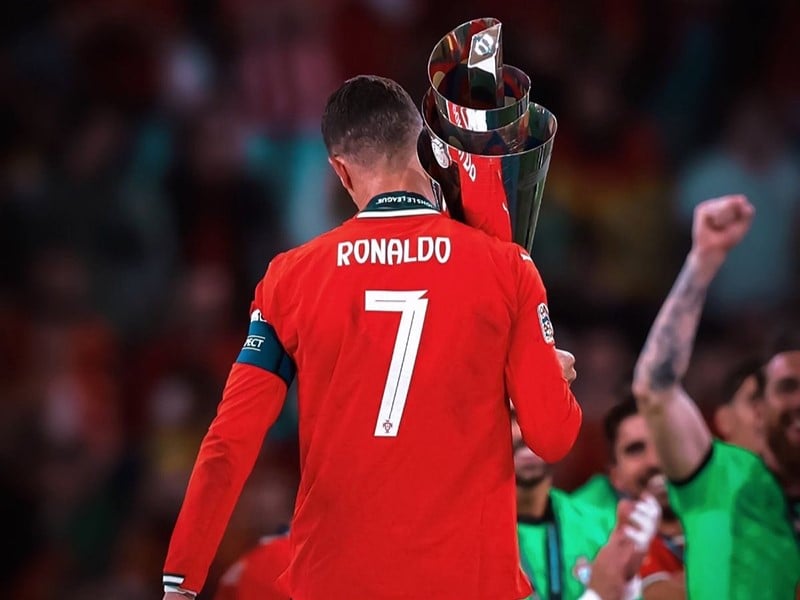
The Euro 2016 victory was followed by another major accomplishment in 2019. Ronaldo scored a hat-trick against Switzerland to lead Portugal into the inaugural Nations League final, which they won. In 2025, he lifted a second Nations League trophy, adding another achievement to an international career that had already surpassed nearly every imaginable individual milestone.
His statistics highlight the scale of his contribution. With 146 goals, Ronaldo finishes as the highest-scoring player in international football history, while his 234 appearances make him Portugal’s most-capped player. An entire generation of Portuguese footballers also grew up in a dressing room where he set the standards expected of everyone.
However, the relationship between Ronaldo and the national team shifted after 2016. The discussion gradually moved from whether he was too individualistic to whether Portugal had become too reliant on him.
His 2018 World Cup display against Spain served as a reminder of his capacity to deliver on the biggest stage. Ronaldo scored three times, including a free-kick that came after 45 attempts in major tournaments, but Portugal were still knocked out by Uruguay.
Following a difficult 2026 World Cup, questions were raised again about his continued presence in the starting line-up. Yet his numbers under Roberto Martinez provided a different view: 28 goals in 37 matches, averaging 0.756 per game, compared with 0.624 under Santos.
The Portuguese Football Federation has announced a special tribute to acknowledge everything Ronaldo has given the national team. It is a fitting gesture, particularly because the circumstances of his retirement have made it hard for supporters to celebrate his departure the way they would have wished.
Portugal did more than watch Ronaldo develop into a football legend. Millions grew up alongside him, and he took the country to heights it had never reached before. His final chapter may not have provided the farewell his achievements deserved, but his place in Portuguese football history is unquestionable.