
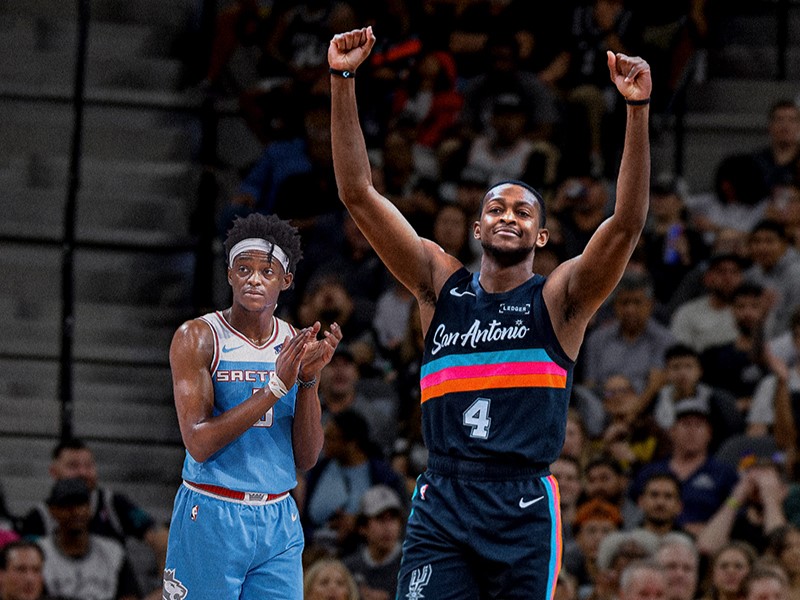
De’Aaron Fox’s performance during San Antonio’s run to the NBA Finals drew significant criticism, particularly because of his inefficient shooting and uneven play against both New York and Oklahoma City. Outside of a strong Game 2 against the Knicks and the decisive basket that secured Game 3, Fox struggled to consistently influence games. His postseason shooting numbers — 41.4% from the field and 29.4% from three-point range — reflected those difficulties.
Yet focusing exclusively on the final rounds overlooks the contributions he made earlier in the playoffs. Fox, an All-Star, scored at least 17 points in nine of the Spurs’ first 11 postseason contests. Even while dealing with an ankle issue that limited his ability to attack the basket, his work in pick-and-roll situations remained one of San Antonio’s most dependable options in half-court offense.
Because of the recency of his struggles, some observers have already begun suggesting that the Spurs should move on from him. However, evaluating his future solely through the lens of a difficult Finals series risks ignoring the broader impact he still provides.
Dylan Harper changes the picture, but not the immediate plan
The arrival of Dylan Harper has naturally altered discussions about the Spurs’ backcourt. Harper is expected to open next season as the team’s starting point guard and is widely viewed as a player capable of reaching All-Star and All-NBA status early in his career. His emergence has transformed Fox from a necessity into something closer to a luxury.
When San Antonio acquired Fox at the 2025 trade deadline, the goal was straightforward: provide Victor Wembanyama with an established co-star and accelerate the franchise’s push toward contention. At the time, Fox filled an important need. Now, with Harper’s rapid development, the roster has more options.
Even so, having an accomplished guard such as Fox remains a significant advantage. The Spurs are no longer dependent on him in the same way they once were, but that does not mean they need to part with him immediately. Instead, his presence offers flexibility and depth for a team with championship ambitions.
Financially, the Spurs are in a comfortable position
One reason San Antonio can afford patience is its salary structure. Victor Wembanyama, Dylan Harper, and Stephon Castle are all still playing on rookie-scale contracts, with the trio set to earn less than $40 million combined next season.
Against that backdrop, Fox’s $49.8 million salary for the upcoming campaign — the first year of his four-year, $229 million contract — becomes easier to accommodate. No other player on the roster is currently scheduled to earn more than $27 million next season.
The organization still has decisions to make regarding players such as Julian Champagnie and free agent Harrison Barnes. Nevertheless, the Spurs remain well below both luxury-tax and apron thresholds, sitting roughly $44 million under the tax line.
Looking further ahead, Wembanyama is eligible for a five-year extension worth $251 million beginning in 2027-28. Even when that contract takes effect, Castle and Harper will still be on rookie deals. In fact, if Fox were somehow to remain for the entire duration of his contract, his salary and Harper’s future maximum deal would overlap for only one season.
A different role could maximize his impact
According to reporting from ESPN, San Antonio continues to view Fox as its starting point guard. At the same time, expectations are growing that Harper will eventually claim a place in the opening lineup.
One possibility is a three-guard starting group featuring Harper, Castle, and Fox. Such an arrangement could allow the Spurs to keep all of their top perimeter talents heavily involved while maintaining continuity.
Another option would be for Fox to embrace a role similar to the one Manu Ginobili famously played in San Antonio. Although Fox possesses the talent to start, leading the second unit could provide the team with a unique advantage. The financial commitment would be substantial for a reserve player, particularly with reigning Sixth Man of the Year Keldon Johnson already on the roster, but the arrangement could strengthen the Spurs’ pursuit of a championship.
If Fox were willing to accept such a transition, he could remain a central contributor while helping the club maximize its overall roster balance.
Depth remains one of San Antonio’s biggest strengths
Roster discussions often assume perfect health, but long NBA seasons rarely unfold that way. Injuries and absences are inevitable, especially for teams hoping to make deep playoff runs.
In many organizations, losing a starting point guard creates major problems. San Antonio, however, has the personnel to withstand such setbacks. With Fox, Harper, and Castle available, the Spurs can continuously stagger their guards and ensure high-level playmaking remains on the floor.
The ideal scenario would see Harper and Castle improve as outside shooters, allowing the three-guard combination to thrive alongside Wembanyama through constant penetration and ball movement. Even if that vision takes time to develop, having three players of that caliber provides a level of security and versatility most teams would gladly welcome.
For that reason, trading Fox simply because of a disappointing Finals showing would be a risky overreaction. San Antonio should remain open to offers, but only if a truly significant return becomes available. Fox is still just 28 years old and averaged 25 points per game with Sacramento two seasons ago.
The Spurs may not have acquired him or signed him to such a lucrative extension had they known Harper would progress this quickly. However, those decisions are already in the past. What matters now is whether Fox can continue helping the franchise chase championships, and there are plenty of reasons to believe he can do exactly that for at least another season.