
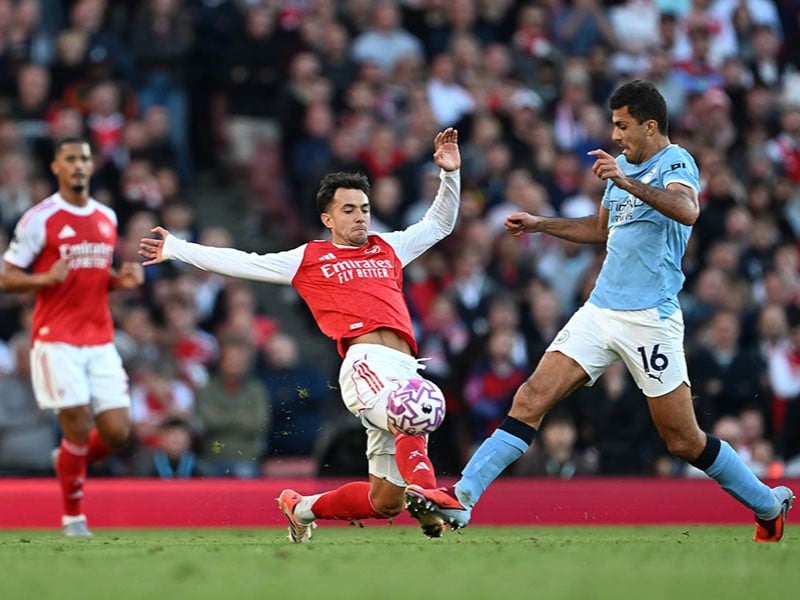
Rodri and Martin Zubimendi went head-to-head again as Manchester City overcame Arsenal 2-0 at Wembley to secure the Carabao Cup. One moment summed up their rivalry: Rodri called for the ball on the edge of the box, received it from Rayan Cherki, and struck low toward the corner, only for Zubimendi to step in and block the effort.
Despite that intervention, Rodri ended the day on the winning side. However, their contest is far from settled. Both midfielders quickly regrouped with the Spanish national team in Madrid ahead of friendlies against Serbia and Egypt, where their battle shifts from club football to international selection.
The competition is not limited to domestic ambitions, as both are also key figures in the Premier League title race. At the same time, they are vying for a place in Spain’s starting lineup, making their rivalry one of the central talking points ahead of the upcoming World Cup.
Can they coexist in the same lineup?
Spain manager Luis de la Fuente has repeatedly addressed whether the two can play together. He has openly praised both, calling them the best in the world in their position and insisting coexistence is possible. Still, reality has not fully matched those words.
The coach has only briefly used them together, notably in the closing moments of the Euro 2024 semi-final against France, when Zubimendi came on in stoppage time. Most of the time, Spain has relied on one or the other rather than pairing them in midfield.
Rodri had long been considered indispensable, even influencing how the team operated. However, his last start came in September 2024 against Switzerland. During his absence due to a knee ligament injury, Zubimendi stepped up and proved that Spain could function effectively without the Ballon d’Or winner.
This has left De la Fuente with a tactical decision: either deploy both in a double pivot—despite favoring a midfield trio with distinct roles—or leave one on the bench. He acknowledges their differences, noting Zubimendi’s increasing presence in attacking areas while both share strong positional awareness and tactical discipline.
Passing the torch and fighting for control
Spain’s reliance on the pair is evident. Out of 3,300 minutes under De la Fuente since March 2023, only 268 have been played without at least one of them on the pitch. Their importance is undeniable, forming the backbone of the team’s structure.
When Rodri was sidelined in 2024, he sent Zubimendi a message: “I’m leaving you the keys of the team.” Now, his return has created uncertainty over whether he will reclaim full control. Rodri himself has experienced similar competition before, referencing his earlier rivalry with Sergio Busquets.
A previous solution under Luis Enrique during the 2022 World Cup saw Rodri used as a centre-back to accommodate both players, but this approach is unlikely to be repeated. Instead, the decision now revolves around balancing the midfield without compromising the team’s structure.
De la Fuente also faces additional selection dilemmas, with players like Pedri, Fermin Lopez, and Fabian Ruiz competing for roles. With only 11 spots available, fitting everyone into the lineup remains a challenge.
Echoes of Spain’s past success
This situation mirrors a familiar debate from Spain’s history. Ahead of the 2010 World Cup, Vicente del Bosque had to integrate both Xabi Alonso and Sergio Busquets into the same team, despite differing opinions across the country.
At the time, some argued for one over the other, but Del Bosque chose to field both. That decision ultimately paid off, as Spain went on to win the tournament, validating the idea of accommodating two players in similar roles.
Now, more than a decade later, Spain faces a comparable challenge. The resolution to the Rodri-Zubimendi question could shape their chances on the biggest stage, with early hints potentially emerging in the upcoming match against Serbia.