
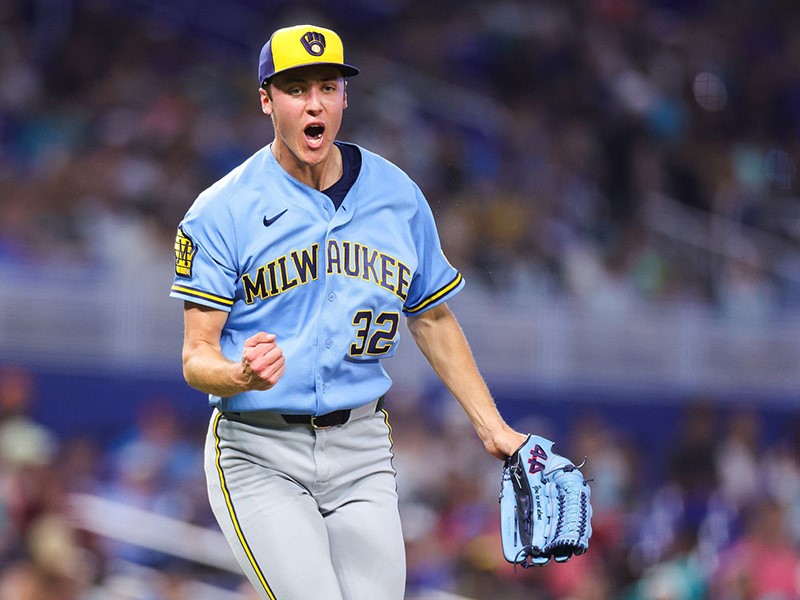
The rise of Jacob Misiorowski has been defined first and foremost by a dramatic escalation in raw throwing speed. Once entering professional baseball as a 2022 draft selection with a fastball sitting in the mid-90s, his power output has climbed steadily through every level of competition, eventually reaching Triple-A, where it averaged around 98 mph before his major league arrival.
After breaking into the big leagues, his velocity took another leap, moving from just under 100 mph on average last season to more than 101 mph in 2026. This progression has separated him from the typical right-handed starter, whose fastball is several miles per hour slower on average.
In one of his standout performances against Philadelphia, he repeatedly worked at triple-digit speeds, even reaching beyond 104 mph on his fastest pitch. That outing included dozens of throws at or above 100 mph, showing that his peak velocity is not occasional but routine.
The consistency of these readings has made his fastball not just a power weapon but the defining feature of his pitching identity, setting a new benchmark for starting pitchers.
Release point and perceived speed
Beyond raw velocity, Misiorowski’s mechanics amplify how fast his pitches appear to hitters. His long stride toward the plate creates elite extension, meaning the ball is released significantly closer to batters than most pitchers manage.
This forward release point produces a measurable increase in perceived speed, effectively making his fastball behave as though it is even faster than the radar gun indicates. His extension has been estimated among the best in the league, placing him in a category few pitchers reach.
That mechanical advantage turns his already extreme velocity into an even more overwhelming challenge for opposing hitters, who have less time to react than the pitch’s raw speed suggests.
As a result, even well-timed swings often arrive late or underneath the ball, contributing to frequent misses and weak contact.
Fastball dominance and usage pattern
A central part of his breakout has been an increased reliance on his primary pitch. Compared to the previous season, he has significantly raised the proportion of fastballs he throws, now using it in well over half of his total pitches.
This approach reflects both confidence in the pitch’s effectiveness and the difficulty hitters face in dealing with it. Even in situations where hitters might expect variation, he continues to lean on his most powerful offering.
The usage rate remains consistently high regardless of matchup or game situation, whether facing left-handed or right-handed batters or working in favorable or unfavorable counts.
Despite having multiple secondary pitches, the fastball has become the foundation of his entire approach, with everything else serving as a complement rather than a primary focus.
Secondary pitches and swing-and-miss results
Although the fastball dominates, his secondary offerings still play an important supporting role. His breaking ball, often described as a curve-type pitch in the article, functions as his most effective complement.
This pitch generates an unusually high whiff rate, even exceeding the swing-and-miss rate of his fastball, and is frequently used to finish at-bats or disrupt timing after repeated high-velocity heaters.
A cutter-like pitch also appears in his arsenal, contributing to variation in speed and movement, while other pitch types are used more sparingly but still regularly enough to keep hitters from focusing solely on the fastball.
Together, these secondary options help maintain unpredictability, even though hitters are primarily forced to prepare for elite velocity.
Command development and strike outcomes
A major shift in his performance profile has come from improved control. Earlier in his career, he struggled with a high walk rate, but in 2026 that number has dropped significantly despite league-wide conditions that generally increase walks.
Interestingly, this improvement does not stem from throwing more strikes in the traditional sense. Instead, his in-zone percentage has slightly declined compared to the previous season, suggesting he is not simply aiming more pitches over the plate.
Rather, the improvement appears linked to increased deception and swing-and-miss ability, with hitters both chasing more pitches outside the zone and making weaker contact when they do swing.
He is also generating more called strikes and fewer successful contacts, showing that dominance rather than conservative pitching has driven his improved control profile.
Performance outlook and statistical dominance
The results of this development are reflected in advanced metrics that place him at the top of the league. His expected run prevention and fielding-independent numbers both rank among the best in baseball, indicating that his success is supported by underlying performance rather than luck alone.
His ERA in 2026 has been exceptionally low, supported by strong indicators such as xERA and FIP that suggest continued effectiveness moving forward. These measures show separation from other elite pitchers in the league.
Even accounting for natural variation in results, the underlying data positions him as one of the most dominant starting pitchers in the game, driven by both elite velocity and improved command.
Taken together, his trajectory suggests a pitcher operating at an unusually high level of performance, with no immediate signs of decline as long as health is maintained.