
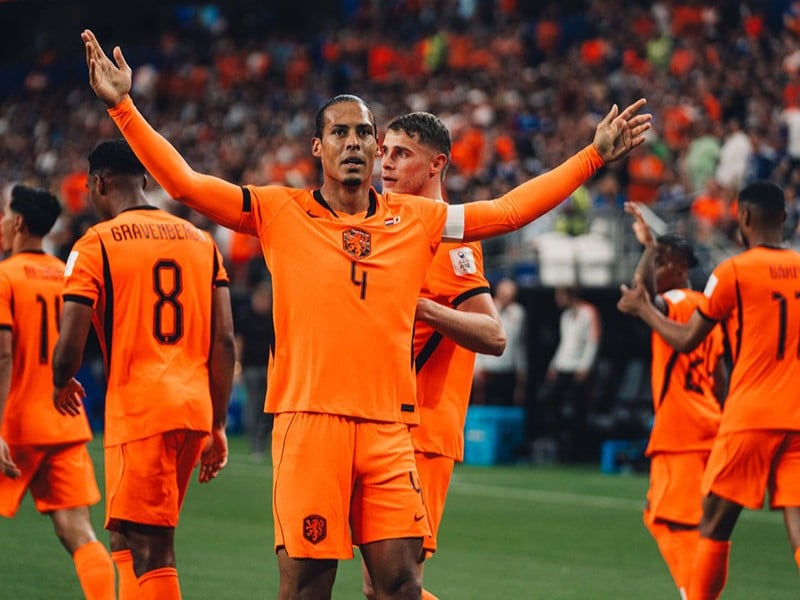
The World Cup has never been solely about what happens during 90 minutes on the field. Every tournament reflects wider stories shaped by history, migration, and identity, with national teams often representing far more than sporting ambition. Some nations have influenced football through their ideas, while others have left their mark by developing players whose careers cross borders.
Few matches at the 2026 World Cup illustrate those themes as clearly as the meeting between the Netherlands and Morocco. While it stands out as one of the most attractive ties in the last 32 on footballing merit alone, the connection between the two countries gives the occasion an added layer of meaning.
The Netherlands reached the knockout stage after finishing first in Group F with seven points, scoring 10 goals to equal their highest-ever World Cup group-stage tally. Morocco also advanced without losing a game, ending the group phase level on seven points with Brazil but taking second place because of goal difference after navigating a section that also included Scotland and Haiti.
When one obvious path became two
For many years, Dutch-born footballers with Moroccan roots were widely expected to represent the Netherlands if they reached the required level. That thinking gradually changed, and international football no longer offers such predictable choices.
Dries Boussatta became the first Dutch-born player of Moroccan heritage to play for the Netherlands when he made his debut against Germany in November 1998 under Frank Rijkaard. Morocco had never attempted to recruit him at that stage, and only later did he switch allegiance after collecting three friendly appearances for Oranje, something FIFA regulations then allowed.
Explaining the transformation purely through political or social factors would overlook the personal nature of these decisions. Family background, cultural identity, and footballing opportunities have all influenced players weighing up their international future, while the relationship between the Dutch and Moroccan football authorities has also evolved significantly over time.
Morocco’s long-term strategy
The 2026 World Cup reflects a broader trend in international football. Nearly one-quarter of all players at the tournament were born outside the nations they now represent, while eight of the 48 participating teams include at least as many foreign-born footballers as locally born ones.
Morocco provides one of the clearest examples of that development. Nineteen members of Mohamed Ouahbi’s 26-player squad were born abroad, and during the group-stage draw with Brazil, they became the first team in World Cup history to field a starting lineup made up entirely of overseas-born players.
That outcome was no coincidence. More than a decade earlier, the Royal Moroccan Football Federation began systematically identifying dual-national players across France, Belgium, Spain, and the Netherlands. Their work focused not only on scouting footballers but also on building relationships with them and their families long before senior international selection became relevant.
Former technical director Pim Verbeek explained that relatives often influenced these choices as much as football itself. The approach steadily changed Morocco’s squad profile. Five Netherlands-born players travelled to the 2018 World Cup, and by the time Morocco reached the semi-finals four years later, 14 members of the 26-man squad had been born outside the country.
A new generation makes different choices
The changing landscape became especially clear through Hakim Ziyech’s international decision. Raised in Dronten and developed entirely within Dutch football, he represented the Netherlands at youth level and earned a senior call-up in 2015 before injury denied him a debut.
Following changes within the Dutch coaching staff after Guus Hiddink’s departure, Ziyech increasingly believed he was not central to the Netherlands’ plans. Morocco offered a different message, maintaining regular contact, presenting a clear sporting project, and making it clear they viewed him as one of the team’s leading figures.
When he committed to Morocco later that year, many observers in the Netherlands were surprised, although the midfielder explained his choice simply by saying he had always felt Moroccan and had followed his heart. His decision changed perceptions because one of the Eredivisie’s standout performers had chosen the Atlas Lions over Oranje.
Other players followed similar paths. Noussair Mazraoui was born in Leiderdorp before progressing through Ajax’s academy, Sofyan Amrabat grew up in Huizen, Anass Salah-Eddine also developed in Dutch football before committing to Morocco, while Ismael Saibari, despite being born in Spain, spent almost all of his football education within PSV Eindhoven’s academy. Whether each player would have secured a regular place for the Netherlands is secondary to the fact they were developed in Dutch football and now represent one of its international rivals.
More than a place in the next round
The connection between the two countries reaches well beyond football. Moroccan migration to the Netherlands increased after labour agreements during the late 1960s, with family reunification later establishing permanent communities. As a result, hundreds of thousands of Dutch citizens today have Moroccan heritage, creating generations whose identities are linked to both nations.
International football, however, requires players to make a single choice. Selecting one national team does not automatically reject the other, but instead often reflects where an individual feels the strongest personal connection. Morocco’s success has changed perceptions to the point where choosing the Atlas Lions is no longer regarded as unusual.
Thirty-two years after Dennis Bergkamp inspired the Netherlands to victory over Morocco at the World Cup in the United States, the relationship between the two football nations has been reshaped. The Dutch continue to be recognised for producing players and footballing ideas, while Morocco has built one of the game’s most effective recruitment systems. Their meeting in Monterrey, therefore, represents more than a knockout fixture, highlighting how heritage, migration, and identity have become an integral part of modern international football.