
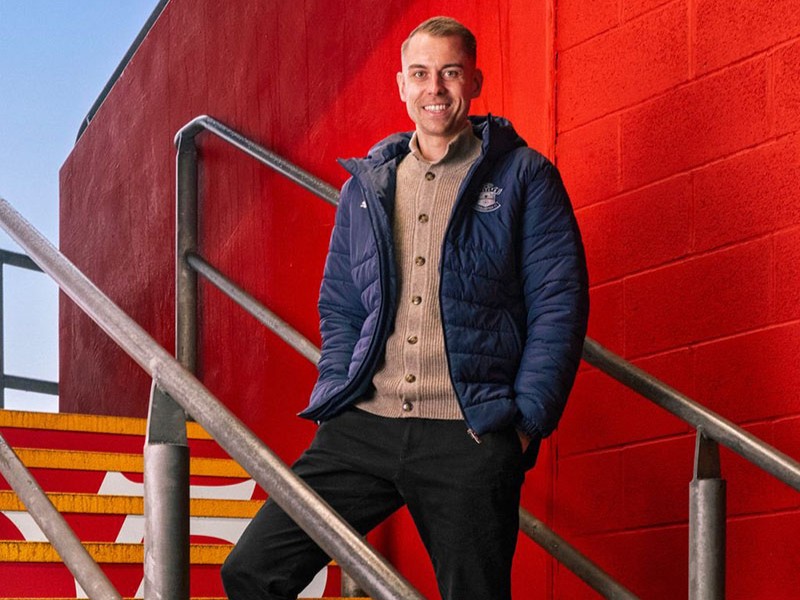
Southampton owner Dragan Solak has confirmed that head coach Tonda Eckert will retain his position despite admitting responsibility for a spying operation targeting Championship opponents. The Saints were removed from the promotion play-offs and handed a four-point deduction for the 2026-27 campaign after acknowledging they had observed rival teams’ training sessions.
Eckert, who took charge permanently in December after a spell as interim boss, transformed Southampton’s season. Having inherited a team battling near the foot of the table, he guided the club to fourth place and a play-off berth. Despite the controversy, Solak said he remains convinced the 33-year-old German deserves continued support.
The Southampton owner described Eckert as an exceptionally gifted coach and stated that, while he would still consult players, supporters, and club officials, his preference would be to keep the manager in charge. Solak also revealed that he had personally warned Eckert about the consequences of any future breaches and insisted the coach must become fully familiar with EFL regulations.
According to Solak, Eckert was unaware that the practice violated league rules. He argued that similar methods are commonly tolerated in countries where the coach had previously worked and expressed hope that the experience would become a valuable lesson rather than a defining moment in Eckert’s career.
Possible FA action remains a concern
While the EFL has already imposed sanctions, the Football Association continues to investigate the affair and could still take action against Eckert. Solak acknowledged that a suspension would prevent the manager from performing his duties but stressed that he would continue to support him personally throughout any proceedings.
The Southampton owner questioned whether additional punishment would be justified, arguing that the club had already paid a heavy price. He pointed to the loss of a chance to secure promotion and the financial rewards that would have accompanied it, describing the sanctions already imposed as excessive.
Should further disciplinary measures be introduced, Solak indicated that the club may consider challenging them. He maintained that Eckert’s achievements on the pitch should not be overlooked, highlighting the dramatic turnaround he oversaw after taking charge of a struggling side.
Solak also rejected suggestions that the spying operation represented a systematic strategy. Referring to the three documented incidents, he argued that if the intention had been to conduct surveillance on a large scale, it would have occurred throughout the season rather than on a limited number of occasions.
Owner disputes severity of punishment
Solak revealed that he first became aware of the controversy through social media and immediately sought clarification from club officials. He claimed that even senior figures within Southampton initially believed the reports were not genuine because they had no knowledge of the operation.
Although he accepted that the club had attempted to obtain information in a manner prohibited by regulations, Solak questioned how much influence the intelligence could have had on actual matches. In contrast, he argued that simulation and attempts to deceive referees occur regularly and can have a more direct effect on results.
Nevertheless, he accepted the league’s desire to eliminate such practices from the game. His disagreement, he explained, centred on the consistency of punishments rather than the principle that the rules should be enforced.
The businessman reiterated his belief that Southampton’s penalty was disproportionate and suggested the club had become an example in a case where the consequences far exceeded the competitive advantage gained.
Questions raised over staff involvement
The disciplinary process also highlighted concerns regarding the role of junior employees. One intern reportedly felt significant pressure to participate in activities that made him uncomfortable and which he considered morally questionable. The commission criticised the use of inexperienced staff members in the operation.
Solak described that situation as unacceptable and acknowledged that the club must improve its internal culture. He said Southampton would work to ensure employees understand they can reject instructions that place them in difficult ethical positions without fearing repercussions.
At the same time, he suggested there had been widespread confusion within the analysis department regarding the regulations. He questioned why British members of staff either failed to recognise the breach or did not raise concerns before the incidents occurred.
Expressing sympathy for the intern involved, Solak said he regretted the experience the employee had endured and revealed that the club had offered him an extended role. He also noted that the original plan involving Middlesbrough would not have broken regulations had it been carried out on the date initially requested, as it would have fallen outside the prohibited 72-hour period.
Fallout extends beyond the disciplinary case
Reports have suggested that some Southampton players are considering departures and may even explore legal options regarding promotion-related bonuses that disappeared when the club was expelled from the play-offs. Solak said he had spoken openly with the squad and praised their conduct despite their disappointment.
According to the owner, the players were understandably hurt by the outcome but handled the situation professionally. He expressed confidence that those with Premier League-level ability would eventually have opportunities to compete at that level, whether immediately or in the near future.
The arbitration panel also criticised Southampton’s early responses to the investigation, noting that the club initially provided inaccurate information about the Middlesbrough incident before later correcting its account. Solak attributed those mistakes to the limited timeframe in which officials were required to respond while preparing for a major fixture.
He insisted that once the formal process was underway, Southampton supplied all relevant information. Looking back on the affair, Solak described himself as devastated by the damage caused and apologised to supporters for the disappointment. Despite the setback, he said his commitment to the club remains unchanged and expressed confidence that Southampton would emerge stronger from the experience.