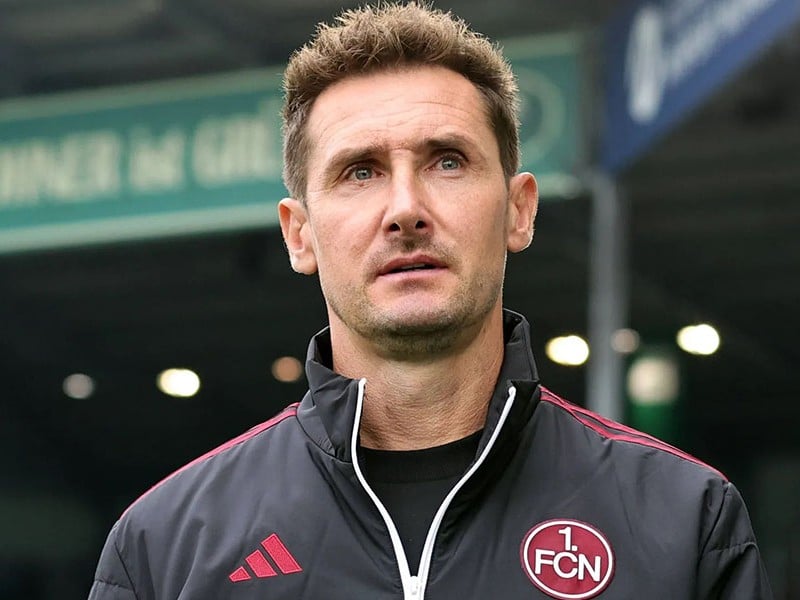
Miroslav Klose understands better than most what it takes to be a prolific goalscorer. Germany’s all-time leading scorer earned his reputation through an exceptional instinct inside the penalty area, and he is now sharing that knowledge with the next generation at 1. FC Nürnberg.
The 48-year-old is applying lessons from his playing career to a young Nürnberg squad, with particular focus on finishing, movement, and the details that transform promising footballers into consistent performers. With his side pushing for promotion to the Bundesliga, Klose is also demonstrating a clear vision for developing young talent.
Miroslav Klose’s philosophy on goalscoring
Klose scored more than 300 goals during a career that took him from Germany’s amateur divisions to Kaiserslautern, Werder Bremen, Bayern Munich, and Lazio. Remarkably, he estimates that all but two of those goals came inside the penalty area. He also remains Germany’s record international goalscorer and, with 16 World Cup goals, sits behind only Kylian Mbappe and Lionel Messi in the men’s tournament standings.
That experience has shaped his approach to attacking football. Klose believes teams need a recognised goalscorer who occupies dangerous positions rather than relying too heavily on false nines or second strikers who constantly drop towards the ball.
For the Nürnberg manager, the quality of the final delivery is just as important as creating opportunities. Whether it comes from a cross, a shot, or another attacking combination, players must understand how to put their teammates in positions where they can finish.
He also stresses the importance of developing automatic movements through repetition on the training ground. Players need to understand one another’s strengths, communicate effectively, and build the kind of connection that makes attacking combinations appear effortless.
Klose’s attention to detail also stems from his own preparation as a player. He regularly studied opposition defenders and goalkeepers, examining their positioning and reactions to different types of shots. Although he insists that goals are a collective achievement, he believes every successful team needs someone capable of delivering the decisive finish.
Harry Kane sets the example for young players
Klose’s own career offers an important lesson in patience and development. Born in communist Poland, he moved to West Germany with his family when he was eight. His father, Josef, was also a professional footballer, but Klose himself did not emerge from a major academy.
Instead, he played in the lower divisions while training as a carpenter before earning an opportunity at Kaiserslautern. Like Harry Kane, he was already in his early 20s when he established himself in top-flight football. Just two years after making his Bundesliga debut, he was starting a World Cup final against Brazil.
His journey eventually culminated in Germany’s 2014 World Cup triumph. At 36, Klose surpassed Ronaldo’s tournament scoring record during the memorable 7-1 semi-final victory over Brazil.
Klose sees similarities between his development and Kane’s career, particularly the England captain’s willingness to improve with experience. He considers the Bayern Munich striker a role model and regularly points his own players towards his example.
“Young players can’t yet have the instinct and experience he has developed, but that’s where it starts – thinking about what you can and can’t do as a footballer,” Klose explains.
He believes talent alone is never enough. Footballers must recognise that training is an opportunity to improve and that development requires consistent effort. In his view, players who become comfortable with praise and assume their progress will happen automatically risk missing important opportunities to get better.
Nürnberg promotion push built around young talent
Klose’s ability to work with younger footballers has become a defining feature of his managerial career. After coaching Bayern Munich’s under-17s and briefly working as Hansi Flick’s assistant, he took his first senior managerial position at Austrian club Rheindorf Altach.
He joined Nürnberg in 2024, guiding the traditionally successful German club to 10th and eighth-place finishes in his first two seasons. The current campaign has brought further progress, with Nürnberg sitting second behind Hertha BSC and sharing the division’s highest goalscoring total. The club are targeting a return to the Bundesliga for the first time since 2019.
According to Transfermarkt, Nürnberg has the youngest squad in Germany’s second division, with an average age of just 23.3 years. Seven of the 11 players with the most minutes this season are 22 or younger, demonstrating the scale of Klose’s commitment to youth development.
Among them is Mohamed Ali Zoma, the team’s leading scorer who has already earned international recognition with Italy. Seventeen-year-old midfielder Marc Kornwachs is another prospect attracting attention.
Klose is nevertheless keen to ensure that promising performances are followed by sustained progress. He believes Kornwachs must become more consistent, establish himself, and continue developing different aspects of his game.
The manager also recognises that young footballers need experienced teammates around them. However, he is willing to trust emerging players with significant responsibilities, even when the result of a match is still in the balance.
Klose’s coaching philosophy and long-term vision
Building a successful youth development structure has required cooperation throughout Nürnberg. When he arrived, Klose held discussions with the club’s academy coaches to understand its identity, existing methods, and footballing philosophy.
There was already considerable agreement, allowing the coaching staff to introduce further ideas in specific areas. Klose believes that the connection between the academy and first team is essential because young players need a clear pathway towards senior football.
He also understands the importance of evaluating each prospect individually. Some may need to improve their physical development, while others are already technically capable of competing at a higher level.
Klose admits that his own development as a manager is still ongoing. Having spent three years in senior coaching, he considers himself a much better manager than when he started but remains committed to learning and working hard.
His preferred style is based on having possession for extended periods, although he acknowledges the need to adapt to different situations. Nürnberg regularly practices alternative ways of playing out of difficult situations, giving the squad greater flexibility on the pitch.
Ultimately, Klose enjoys helping individual players progress while building a team capable of controlling matches. It is an approach that reflects his own career: a footballer who reached the highest level through hard work and is now determined to give the next generation the same opportunity.