
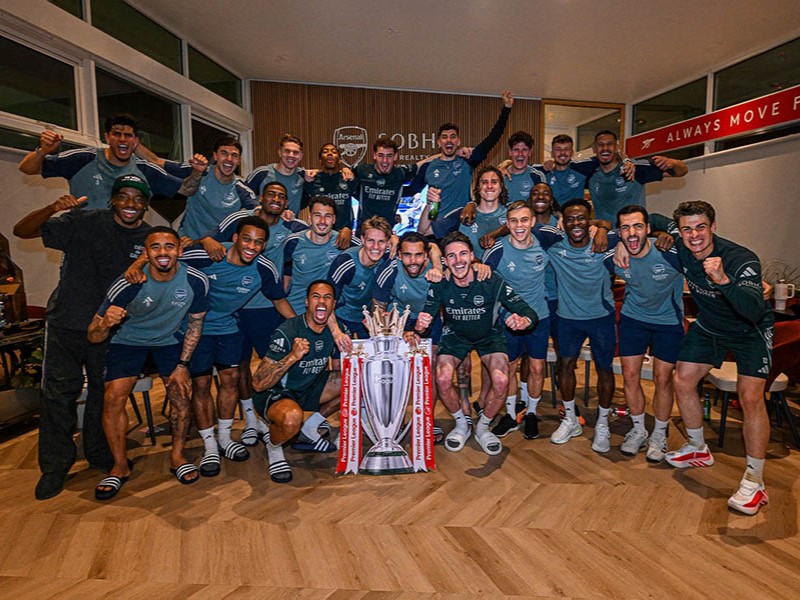
Arsenal’s first Premier League title in 22 years was confirmed after Manchester City drew with Bournemouth, bringing an end to a journey that had been years in the making under Mikel Arteta. The success was shaped by unusual moments and methods, from motivational speeches and symbolic fires at the training ground to an AI-generated TikTok song that became popular among the squad during the campaign.
Arteta has often focused on creating strong relationships inside the club. Barbecues involving players, staff and families at London Colney became part of the culture he tried to build, while during a difficult spell last month he encouraged his squad to throw negative thoughts into a fire lit at the training base. Arsenal recovered from that dip in form and finished the season as champions, with attention now turning towards the Champions League final against Paris St-Germain in Budapest.
The title is viewed internally as the reward for a carefully planned project that began when Arteta told supporters to “trust the process” in 2020. The Spaniard has overseen the transformation of Arsenal into one of Europe’s strongest teams, but many figures behind the scenes also contributed to the rise. Former sporting director Edu, assistant Jason Ayto, technical director James Ellis, and football intelligence chief Mark Curtis all played major roles in reshaping the squad through recruitment.
Much of the current team was assembled during Edu’s period at the club, with 10 of Arsenal’s 15 most-used Premier League players this season signed under his leadership. Chief executive Richard Garlick strongly supported the rebuilding strategy, while co-chairman Josh Kroenke increased his involvement in football matters and regularly visited the training ground throughout the campaign.
Squad unity and difficult moments along the way
Arsenal’s success did not arrive without setbacks. The team missed several opportunities to pull clear in the title race and also suffered disappointment in the Carabao Cup final defeat by Manchester City. Arteta’s decision to select Kepa Arrizabalaga at Wembley backfired after an error from the goalkeeper contributed to the loss.
Despite those frustrations, Arsenal appeared stronger after another league defeat by City intensified the title battle. Arteta increasingly relied on instinct and emotion in his decision-making, something that had not always been the case earlier in his managerial spell. His unconventional approach continued through the season, including the use of the AI-generated song featuring every squad member and one of his favourite phrases, “make it happen”.
The atmosphere around the club was also strengthened by the academy’s contribution. Bukayo Saka, Ethan Nwaneri, Myles Lewis-Skelly and Max Dowman all emerged from Arsenal’s youth system and became symbols of the club’s long-term planning. Dowman’s rapid rise especially caught attention after he appeared in the squad photo before the season despite being only 15 at the time.
Defensively, Arsenal built their title challenge around the partnership of Gabriel Magalhaes and William Saliba, while Declan Rice, David Raya and Gabriel were among the key performers across the campaign. Rice played more minutes than any other outfield player and preferred maintaining a constant rhythm by featuring multiple times each week.
Arteta’s influence grows at the club
Arteta’s authority inside Arsenal has expanded significantly since his role changed from head coach to manager in 2020. He now sits on the football leadership group alongside Josh Kroenke, Richard Garlick, James King and sporting director Andrea Berta, with the group responsible for shaping the direction of the club.
His coaching staff mirror his demanding personality, with analysts and assistants heavily involved during matches and training sessions. Former Argentina defender Gabriel Heinze joined the staff last summer and quickly made an impact, introducing a motivational pre-match huddle for defenders that became a regular feature throughout the season.
Although Arteta remains heavily involved in every aspect of coaching, he has also become more willing to delegate responsibilities to his assistants to prevent players from becoming fatigued by hearing only one voice. His balance between strict discipline and detailed coaching has become an important feature of Arsenal’s environment.
The club are already working towards extending Arteta’s contract beyond next season. Discussions are expected to intensify after the Champions League final, with all sides wanting an agreement completed before the start of the next campaign. Arsenal are also considering improving Berta’s deal amid interest from Saudi Arabia.
Recruitment, transfers and planning for the future
Preparations for this title-winning campaign began during a meeting in the United States in November 2024, where club executives and Kroenke discussed future objectives. Berta officially became sporting director in March 2025 following Edu’s departure to Evangelos Marinakis’ group of clubs, and quickly gained popularity among supporters after overseeing a major transfer window.
Arsenal spent £250m last summer, focusing on physically strong players with strong injury records. Berta’s influence was particularly visible in the signing of Viktor Gyokeres, who eventually became the club’s main striker target ahead of Benjamin Sesko. Alexander Isak and Julian Alvarez were admired internally, but their potential fees were considered too expensive.
Arteta initially needed convincing before approving the move for Gyokeres, but Arsenal pushed hard to complete the transfer before their pre-season tour in Asia. The Swedish forward struggled during the first half of the campaign but improved dramatically after the March international break, eventually reaching 21 goals in all competitions.
Attention has already shifted towards the next transfer window. Arsenal want to strengthen midfield, left wing and attack, though there will also be a stronger focus on player sales after last year’s spending. Jakub Kiwior is set to join Porto, while the club may consider offers for Ben White, Gabriel Martinelli, Gabriel Jesus and Fabio Vieira.
There have also been internal discussions over a major academy sale to help the club financially, including conversations involving Ethan Nwaneri and Lewis-Skelly. At the same time, Arsenal must manage increasing wage costs after handing out several new contracts and preparing improved deals for players such as Jurrien Timber and Declan Rice.
The club are already thinking about the next generation of the squad as some senior players approach their late 20s. Arsenal are interested in Leicester youngster Jeremy Monga, while Dowman, Marli Salmon, Edwin and Holger Quintero are viewed as part of the club’s future plans. After finally delivering the Premier League title, Arsenal is now trying to build a team capable of sustaining success for years to come.