
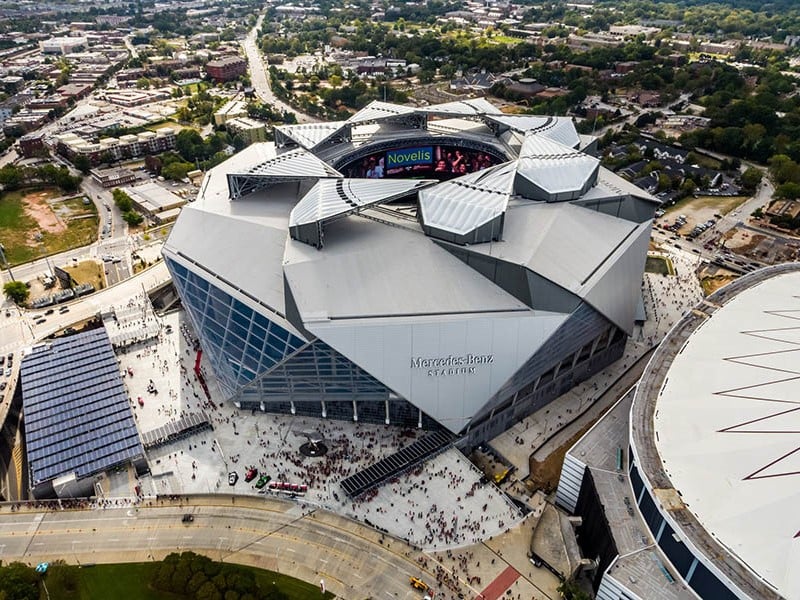
Opened on August 26, 2017, Mercedes-Benz Stadium became Atlanta’s modern replacement for the Georgia Dome, introducing a $1.6 billion venue owned by the state of Georgia through the Georgia World Congress Center Authority and operated by AMB Group. Serving as home to the NFL’s Atlanta Falcons, MLS’s Atlanta United FC, and an incoming NWSL expansion club, the multi-purpose facility quickly established itself as one of the city’s defining landmarks.
The venue has already hosted an impressive lineup of major occasions that once belonged to its predecessor, including the SEC football championship, the Peach Bowl, and College Football Playoff National Championships in 2018 and 2025. It also staged the 2018 MLS Cup, where Atlanta United triumphed on home turf, along with Super Bowl LIII in 2019. Looking ahead, the stadium is scheduled for Super Bowl LXII in 2028 and multiple matches during the 2026 FIFA World Cup.
For Atlanta United, the massive scale has not diminished matchday energy. Despite being one of Major League Soccer’s largest home grounds, the club consistently led MLS attendance figures before the pandemic with crowds averaging above 50,000, while the enclosed design amplifies crowd noise and reinforces its reputation for an electric environment.
Innovative design and engineering at the heart of the venue
The stadium’s most recognizable architectural element is its retractable roof, built around eight translucent triangular panels arranged in a pinwheel formation. These sections move along paired rails, with one guiding motion and the other ensuring stability. When fully opened, the structure resembles outstretched wings, while architect Bill Johnson drew inspiration for the circular opening from Rome’s Pantheon.
Constructed with lightweight clear polymer capable of adjusting opacity, the roof works alongside extensive glass and transparent exterior materials to create both natural light and expansive outside views. The engineering also allows the roof to remain open during light rain, supported by outdoor-rated electrical systems and a field drainage network.
Suspended beneath this roof is the Halo video board, a massive ring-shaped display measuring 58 by 1,100 feet and covering 62,350 square feet. Daktronics described it as triple the size of the NFL’s previous largest single display installation. Additional LED boards totaling more than 20,000 square feet further enhance both football and soccer presentations.
Built for versatility, spectacle, and culture
Mercedes-Benz Stadium was designed with flexibility in mind, adapting to the differing demands of professional football, college football, and soccer. Two oversized locker rooms were included from the outset to accommodate 100-player college rosters, while retractable lower bowl seating and mechanized curtains allow a soccer-specific arrangement with reduced capacity and expanded field dimensions.
Though college football infrastructure was prioritized, one notable omission at opening was direct seat-to-field stair access for marching bands, creating logistical challenges for halftime performances. Still, the venue’s broader adaptability has made it one of the nation’s premier event destinations.
Art also plays a central role throughout the property, with more than 180 commissioned pieces integrated into both interior and exterior spaces. Among works from artists such as Nari Ward, Hank Willis Thomas, Gregory Eltringham, and Steven and William Ladd, the most dramatic is Gábor Miklós Szőke’s “The Atlanta Falcon,” a towering stainless steel sculpture standing 41 feet high with a 70-foot wingspan atop a bronze football.
Exploring Atlanta beyond the stadium
Atlanta’s appeal stretches far beyond sports, with the Atlanta Botanical Gardens offering visitors a peaceful retreat through themed spaces such as the Canopy Walk, Japanese Garden, Rose Garden, Fuqua Conservatory, Orchid Centre, and Skyline Garden. Even outside peak bloom, the gardens provide a rich experience, from tropical displays to city views and colorful seasonal installations.
The World of Coca-Cola presents another signature attraction, immersing guests in the story of The Coca-Cola Company through exhibits on its history, the famed recipe vault, a working bottling line, scent-based beverage exploration, and a tasting room featuring more than 60 drinks from around the world.
For historical reflection, the Martin Luther King Jr. Memorial Complex offers access to significant locations, including his birthplace, Ebenezer Baptist Church, The King Centre, and his tomb. Combined with the International Civil Rights Walk of Fame and surrounding commemorative spaces, the site provides a meaningful look at civil rights history.
Atlanta’s cultural heritage is equally evident at the Fox Theatre, a 1929 landmark that blends architectural influences from Spain, Egypt, and the Far East. From its famous opening with “Steamboat Willie” to its grand interior, star-lit ceiling, and legendary “Mighty Mo” organ, it remains one of the city’s enduring entertainment treasures.