
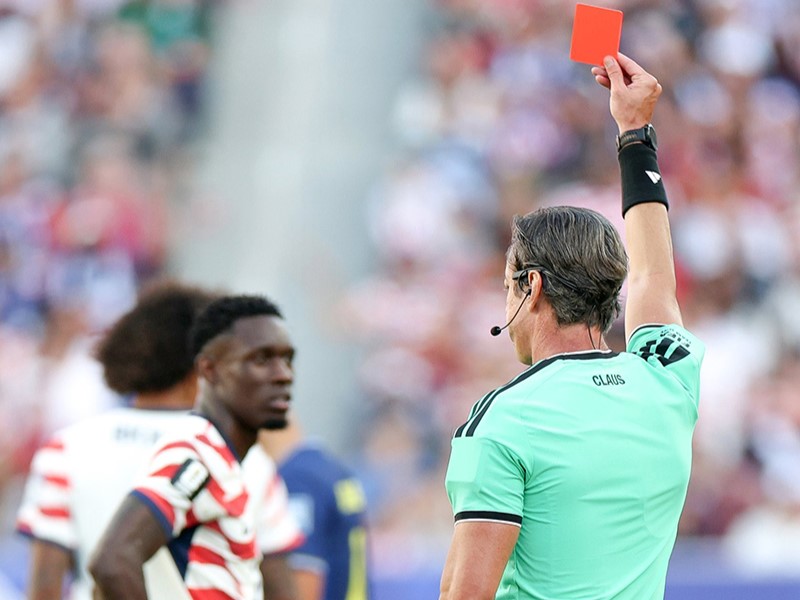
It had long been considered a certainty in World Cup football that any player sent off would automatically miss the next match, with no appeals or exceptions. However, that expectation was challenged in the case of United States forward Folarin Balogun.
Balogun, who was sent off during the last-32 win over Bosnia-Herzegovina, had initially been expected to serve a suspension that would rule him out of the last-16 match against Belgium. Instead, he will now be available for selection after a decision that effectively removed or suspended his ban.
Across World Cup history, there have been 189 red cards, and only two cases in which players did not go on to serve suspensions. One of those dates back to 1962, involving Brazil’s Garrincha, when disciplinary decisions were handled differently and there was no automatic ban system in place.
Questions over the FIFA disciplinary code
FIFA’s disciplinary committee has not provided a public explanation for the decision, instead referencing article 27 of its disciplinary code. That article allows the governing body to fully or partially suspend the implementation of disciplinary measures, giving it broad authority without requiring detailed justification.
The rule had never previously been applied in a World Cup context. In Balogun’s case, the suspension is also noted as being for one match rather than the standard two-match ban for serious foul play outlined in the disciplinary regulations.
The situation has raised comparisons with previous disciplinary cases, including Cristiano Ronaldo’s suspended ban for an incident in international qualifying, as well as pre-tournament disciplinary decisions involving players such as Laurent Koscielny, Moisés Caicedo, and Nicolás Otamendi.
Reactions from Belgium and pundits
The decision prompted strong reactions from Belgium’s football authorities, who said they were “astonished” that Balogun had been cleared to play. They argued that tournament regulations state a player receiving a red card “will automatically be suspended” for the next match.
Belgium coach Rudi Garcia criticised the ruling in strongly worded comments, suggesting that the situation made the World Cup feel inconsistent with its own rules. His remarks reflected wider frustration over what was seen as an unexplained departure from established disciplinary practice.
Media and pundit reaction was also critical. BBC Sport analyst Micah Richards described the situation as a “farce,” arguing that it undermined confidence in how disciplinary decisions are applied during major tournaments. The lack of published reasoning from Fifa was repeatedly highlighted as a key concern.
Political involvement and wider implications
Reports cited by CBS News indicated that the decision followed communication between FIFA president Gianni Infantino and US president Donald Trump, with other US officials also reportedly involved in discussions about the suspension. FIFA did not provide a detailed public explanation for how the final decision was reached.
The involvement of political figures led to further scrutiny, particularly given FIFA statutes that emphasise political neutrality in football governance. Questions were raised about whether external pressure influenced the disciplinary outcome.
The case has also sparked broader debate about precedent and consistency in football discipline. Critics argued it could encourage future challenges to red cards, while others pointed to previous controversial cases involving on-field incidents and varying lengths of bans across competitions.