
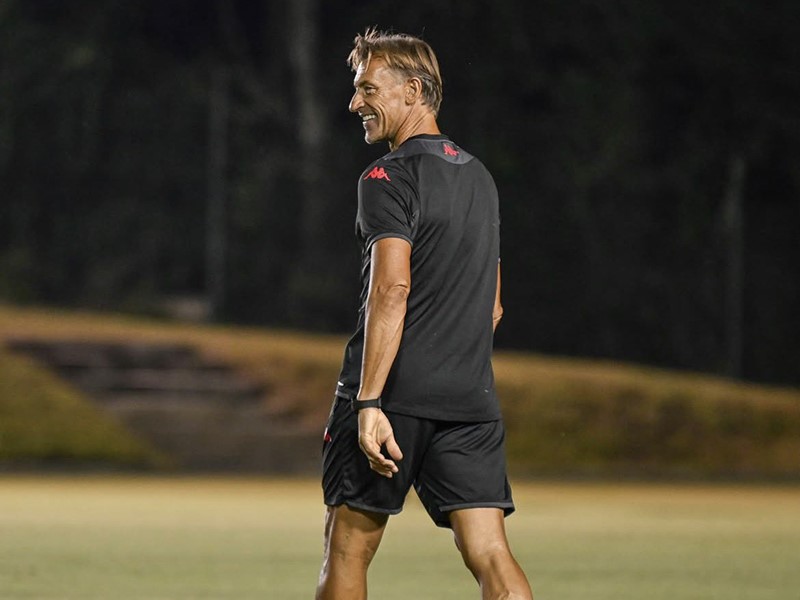
Tunisia have turned to Herve Renard in an effort to revive their 2026 World Cup campaign after a crushing 5-1 defeat against Sweden in their opening Group F match. The heavy loss prompted the Tunisian Football Federation to dismiss Sabri Lamouchi immediately, making the Carthage Eagles the first team in World Cup history to replace a coach after just one game at the tournament.
Despite the setback, the expanded 48-team format means Tunisia still has an opportunity to reach the knockout stage. However, Renard faces immediate pressure, with little room for further mistakes as he prepares for Sunday’s meeting with Japan.
The Frenchman accepted the challenge without hesitation after being contacted by the federation. Renard described the situation as difficult but motivating, embracing the opportunity to guide Tunisia through a complicated moment.
His appointment also places him among a small group of coaches who have managed different nations at three consecutive World Cups. After leading Morocco in 2018 and Saudi Arabia in 2022, he now takes charge of Tunisia at the 2026 finals.
From overnight cleaner to international coach
Renard’s route into management was far from conventional. After ending his playing career at SC Draguignan at the age of 29, he began coaching while simultaneously working as a cleaner to support himself.
For eight years, his daily routine involved waking up during the night, carrying out cleaning duties in residential buildings until midday, and then leading training sessions later in the day. He balanced those responsibilities while studying for coaching qualifications.
Looking back, Renard has often described that period as one of the most valuable experiences of his life. The physically demanding work helped shape his character and taught him the importance of perseverance through difficult circumstances.
Those challenging years eventually laid the foundation for a coaching career that would take him across clubs and national teams on several continents.
Building a reputation across Africa and beyond
Renard’s first major opportunity arrived in 2002 when he became an assistant to fellow French coach Claude Le Roy at Shanghai Cosco. He later followed Le Roy to Cambridge United before establishing himself as a head coach.
His greatest achievements came in African football. Renard remains the only coach to win the Africa Cup of Nations with two different countries. He guided Zambia to a memorable title in 2012 before lifting the trophy again with Ivory Coast three years later.
According to Zambian journalist Nkweto Tembwe, Renard earned a reputation as a dedicated worker and meticulous strategist. Tembwe described him as someone who studies opponents thoroughly and constantly seeks to keep pace with developments in the game.
Although he enjoyed continental success, Renard was unable to capture an African title with Morocco, whose campaigns ended in the quarter-finals in 2017 and the last 16 in 2019. He later coached France’s women’s national team, reaching the quarter-finals at both the 2023 Women’s World Cup and the 2024 Olympic Games.
A coach always in demand
Renard has regularly attracted interest whenever African federations have searched for a new manager. Yet his availability and salary expectations have often complicated negotiations.
During the 2023 Africa Cup of Nations, Ivory Coast attempted to bring him back after dismissing Jean-Louis Gasset during the competition. However, the French Football Federation declined to release him from his contract with the women’s national team.
Nigeria also explored the possibility of hiring Renard in 2024, but a football official later described his financial requirements as excessively high.
Tunisia becomes the fifth African national team he has managed. His previous experience on the continent includes spells with Zambia, Ivory Coast, Morocco, and Angola, while he also worked as an assistant with Ghana.
The task facing Tunisia
Renard’s first priority will be improving Tunisia’s defensive performances. The defeat against Sweden followed another heavy loss, a 5-0 setback against Belgium in the team’s final preparation match before the tournament.
After the Sweden game, Lamouchi admitted that Tunisia had committed too many errors. Renard, known for demanding discipline from his squads, has already urged the players to move on from the defeat and focus on representing their country with pride.
Tembwe believes the French coach’s motivational abilities have often made the difference. He recalled Renard’s team talk before Zambia’s Africa Cup of Nations semi-final victory over Ghana, arguing that the match was effectively won before the players stepped onto the field.
Renard’s previous encounters with Japan during World Cup qualifying campaigns with Saudi Arabia may also prove useful. Tunisia’s hopes of reaching the knockout rounds for the first time now rest largely on whether he can inspire another turnaround and add a new accomplishment to an already remarkable managerial career.