
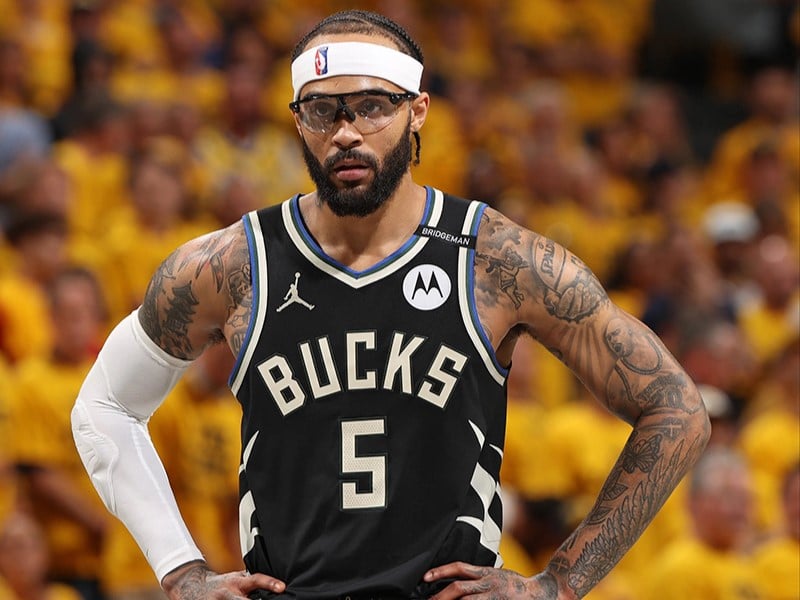
The NBA has confirmed it will review Gary Trent Jr.’s new contract with the Milwaukee Bucks after the agreement immediately prompted widespread discussion about possible salary cap circumvention. The guard, who is coming off the least productive campaign of his career, secured a fully guaranteed four-year deal worth $64 million despite expectations that his market value would remain close to the minimum salary.
That outcome surprised many observers because Trent’s previous two contracts reflected a far more modest market. He accepted a minimum contract in 2024 before returning the following year on a deal made possible through Non-Bird Rights, which allowed only a 20% increase over his previous salary. Considering the stricter financial environment created by the 2023 Collective Bargaining Agreement, many believed another low-cost contract was the most realistic outcome.
Instead, Milwaukee committed significant long-term money, making Trent’s agreement one of the biggest contracts awarded during this free agency period. The size of the deal quickly fueled speculation that there could have been an understanding between player and club long before the latest negotiations officially began.
How Bird Rights became central to the debate
The discussion largely revolves around the NBA’s Bird Rights system, which enables teams to exceed the salary cap when re-signing their own players. Outside free agents generally require cap space or an available exception, but players who remain with the same franchise gradually unlock greater financial flexibility through Non-Bird, Early Bird, and eventually full Bird Rights.
When Trent entered free agency in 2024, he had just completed a three-year, $51 million contract and was initially expected to earn a comparable salary. According to reports at the time, however, interest never developed as anticipated, leaving his strongest offers around the taxpayer mid-level exception of roughly $5.2 million.
Milwaukee, already operating deep into the luxury tax, could offer only a minimum contract, which Trent accepted while joining a roster featuring former teammate Damian Lillard. One year later he remained with the Bucks through Non-Bird Rights, and in 2026 he agreed to a contract worth $64 million over four seasons—only $4 million below the maximum permitted under Early Bird Rights.
Why critics question the timing of the contract
From a basketball standpoint, many have struggled to explain the financial commitment. Trent averaged 8.1 points in 21.2 minutes per game last season, temporarily lost his place in Milwaukee’s regular rotation, and contributed little in areas such as defense, rebounding, and playmaking. The Bucks also possess considerable depth in the backcourt, making the investment appear even more unexpected.
Those circumstances have led to speculation that an informal promise may have existed when Trent first arrived in Milwaukee or when he re-signed the following year. The theory suggests he accepted below-market contracts with the understanding that he would later receive a much larger payday after the team gained the necessary Bird Rights.
Comparisons have naturally been drawn with the Minnesota Timberwolves’ Joe Smith case in 1999. Smith accepted a contract below his perceived market value before later expecting a much larger agreement once full Bird Rights became available. That case ultimately resulted in severe penalties after investigators uncovered written evidence of the arrangement. While no such evidence has surfaced regarding Trent, the overall contract structure has prompted similar questions, even though his deal relied on Early Bird rather than full Bird Rights.
Speculation surrounding Trent’s future was already circulating before free agency officially opened. On his podcast, The Ringer’s Zach Lowe said league insiders had been discussing for months the possibility that Trent would receive an unusually large contract once his Early Bird Rights became available, making the final agreement less surprising to those around the NBA.
Bucks’ history and the league’s next step
Milwaukee has previously faced league discipline for violating free agency rules, although not for salary cap circumvention. In 2020, reports indicated the Bucks had reached a sign-and-trade agreement for Bogdan Bogdanović before free agency officially began, resulting in the loss of a second-round draft pick.
The franchise has also successfully used the Bird Rights system in the past to retain players who initially signed for smaller contracts. Bobby Portis joined Milwaukee using the biannual exception in 2020, received a limited Non-Bird raise after helping the team win a championship, and later signed a four-year, $48 million contract through Early Bird Rights in 2022.
The NBA is also continuing a separate cap circumvention investigation involving Kawhi Leonard and the Los Angeles Clippers, highlighting how difficult such cases can be to establish. Under Article 13 of the Collective Bargaining Agreement, however, the league may rely on both direct and circumstantial evidence, including situations where a contract cannot be reasonably explained without violating league rules.
Milwaukee and Trent can point to his age and the possibility of future improvement as justification for the agreement. Nevertheless, given his recent production and the cautious approach taken by teams across this free-agent market, the contract has become one of the most closely examined deals of the offseason, and the league will now determine whether there is any basis for further action.