
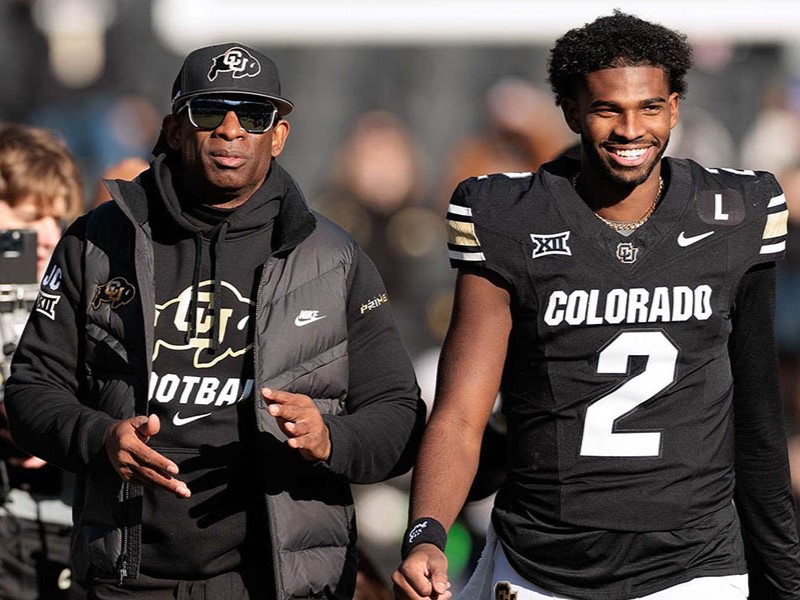
For much of the past year, Deion Sanders remained publicly restrained while Shedeur Sanders dealt with relentless scrutiny that began during the draft process and continued into his rookie campaign with the Cleveland Browns. Once viewed as a likely early-round selection, Shedeur instead slipped to Day 3 after what Deion described as false narratives and damaging claims about his professionalism circulated before the draft.
Speaking on The Barbershop podcast, Deion directly challenged reports that questioned his son’s preparation and conduct, rejecting suggestions that Shedeur entered meetings unready or displayed poor habits. He said those portrayals were completely out of character for a player who had already achieved so much through discipline and preparation.
Although Deion admitted those accusations personally affected him, he emphasized that Shedeur remained focused on earning his chance on the field. According to him, his son’s priority was never responding to outside criticism but proving himself through performance.
Anonymous critiques from NFL evaluators, including one especially harsh review of a pre-draft interview, only intensified doubts around Shedeur’s stock. Questions about his demeanor and system fit added to the uncertainty, turning what was once seen as first-round potential into a far more difficult entry into the league.
A rookie season centered on survival and growth
Shedeur’s first NFL year became less about immediate stardom and more about enduring adversity. Forced into action for seven starts during a turbulent season, he tried to steady himself while adjusting to the speed and demands of the professional game.
Deion said the experience left visible marks, both physically and spiritually. In one of his most striking comments, he described seeing “scars” on his son’s back, using that image to symbolize everything Shedeur had endured throughout the past year and a half.
Rather than framing the ordeal as defeat, Deion portrayed it as transformation. He explained that Shedeur came through the experience stronger and more spiritually mature, understanding that the timing many expected for his rise simply had not arrived yet.
Despite the difficult road, Deion’s message was that his son survived the pressure, disappointment, and criticism — and emerged changed by it.
Browns reset quarterback competition under Todd Monken
Cleveland’s quarterback situation now enters a new phase with first-year head coach Todd Monken overseeing what has been labeled an open competition. The Browns’ approach appears more structured than in recent years, with Monken expected to evaluate Shedeur Sanders and Deshaun Watson while bringing greater clarity to a position that has long lacked stability.
Monken’s background, including his previous work with Lamar Jackson in Baltimore, has created hope that his system can establish order. His offense emphasizes timing, decision-making and anticipation, placing less value on improvisation and more on efficient execution.
For Cleveland, the focus is no longer purely on physical tools but on identifying which quarterback can consistently operate within structure and avoid costly mistakes. The franchise’s long-running struggles at the position have made functional reliability a priority over highlight plays.
The Browns used three quarterbacks in 2025 — Joe Flacco, Gabriel, and Sanders — while Watson missed the season after suffering another Achilles setback. Heading into this year, Sanders, Watson, Dillon Gabriel, and rookie Taylen Green are all under contract, setting the stage for a crowded evaluation.
Sanders’ production and Deion’s desire to help
Shedeur’s rookie numbers reflected both opportunity and difficulty. He completed 57% of his passes for 1,400 yards, seven touchdowns, and 10 interceptions while also adding 169 rushing yards and one score. He was sacked 23 times and finished with one of the league’s lowest passer ratings.
As Cleveland begins offseason practices, Deion has made clear that he wants to contribute — not as a father, but as a coach who understands how to maximize Shedeur’s strengths. He expressed frustration that such conversations did not happen previously and questioned why teams would not seek insight from someone who coached players like Shedeur and Travis Hunter for years.
Deion believes that firsthand knowledge of what motivates or hinders a player can be valuable to an NFL staff, particularly during a developmental stage. His comments suggest he sees collaboration, rather than distance, as beneficial.
Ultimately, Cleveland’s future at quarterback may depend less on reputation and more on Monken’s ability to identify who can best command his system over a full season. For a franchise with only three playoff appearances since 2000, solving that puzzle remains central.