
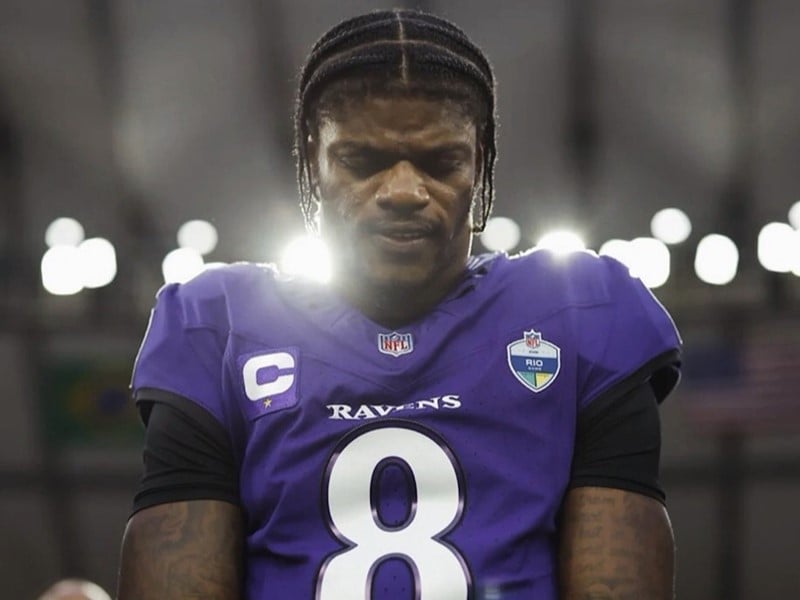
Lamar Jackson’s most recent injury has cast new doubt over his future with the Baltimore Ravens, as the quarterback now faces a lengthy period on the sidelines following surgery on his right thumb.
Jackson’s comeback from a three-game absence due to a high ankle sprain survived only a single offensive snap against the Buffalo Bills. The 36-10 loss delivered yet another blow when his throwing hand collided with Bills edge rusher Greg Rousseau as he began a passing motion. Jackson has since been moved to injured reserve and is out with no clear return date.
The setback could carry major consequences for Baltimore’s planning, especially since Jackson is set to enter the final year of his contract in 2027. Although a long-term partnership remains possible, the two parties have still not reached an extension, and multiple clauses in the quarterback’s deal grant him substantial influence over what comes next.
Lamar Jackson’s contract gives the Ravens’ quarterback leverage
Jackson is presently in the fourth season of a five-year arrangement that originally made him the NFL’s highest-paid player, carrying an average annual salary of $52 million. His scheduled 2027 earnings include a $51.25 million base salary and a $750,000 workout bonus, though the contract also comes with a massive $84.34 million salary cap hit.
Two specific provisions make the situation especially tricky for Baltimore. Jackson holds a no-trade clause, which means the Ravens cannot move him without his consent, and the team is also barred from using the franchise or transition tag once his contract expires after the 2027 season.
Owner Steve Bisciotti reportedly hoped to lock in an extension before the 2026 league year began in March. Yet Jackson, who represents himself and has never worked with an agent, was reportedly the reason talks failed to advance.
Baltimore later restructured his contract to open up $39.96 million in salary cap space for 2026. The adjustment featured a dummy contract year for 2030, which let the team spread bonus payments across additional seasons.
The financial picture makes another agreement increasingly critical. The Ravens currently have $366.74 million committed to 45 players for 2027, giving them the NFL’s highest projected cap commitments. With the league’s salary cap expected to land between $322.5 million and $327.5 million, Jackson’s existing figure is hard to fit.
Injury concerns and Jackson’s next NFL contract
Jackson’s recent availability could become a factor in negotiations. Injuries to his hamstring, ankle, toe, knee, back, and thumb have restricted him to 18 appearances out of a possible 34 regular-season games across 2025 and 2026, assuming he does not return this season. By contrast, he missed only one game during the two previous campaigns.
Even so, his performances before the ankle injury showed why Baltimore would be hesitant to let him go. In four appearances during the 2026 season, Jackson completed 68 of 96 passes for 967 yards, six touchdowns, and one interception, posting an 119.6 passer rating.
He also added 144 rushing yards on 19 carries, including one touchdown. His 70.8% completion rate was a career high, while his passer rating matched his best single-season mark from 2024. He was also on pace to set career highs in yards per attempt and yards per completion, with the Ravens sitting at 3-1 and sharing first place in the AFC North.
The limited availability may still make Baltimore wary of handing another market-setting contract to a quarterback who turns 30 in January. None of Jackson’s injuries, however, have been classified as career-threatening.
Patrick Mahomes offers an intriguing point of comparison. Kansas City reworked his contract in June even though the quarterback was coming off a torn ACL and LCL in his left knee and a disappointing 2025 campaign. Mahomes had posted career lows in completion percentage and passer rating as the Chiefs finished 6-11.
His revised agreement added two years and runs through 2033, covering eight years and $504.75 million, with an average annual value of $63.1 million. The deal can reach $522.25 million through escalators and incentives, while including $237 million in conventional guarantees, of which $150 million was fully guaranteed at signing. His average salary also topped the $60 million per year Dallas gave Dak Prescott in 2024.
Lamar Jackson trade scenario and potential compensation
Jackson’s reported unwillingness to hold serious contract discussions has fueled speculation that he may not wish to stay in Baltimore. A trade could emerge as an option, but the no-trade clause means the quarterback would have to sign off on any move.
Timing would also carry a major financial impact. A trade before the 2027 NFL Draft, scheduled for April 29 through May 1, would leave the Ravens with $74.81 million in dead money. That would save only $9.53 million against Jackson’s $84.34 million cap hit.
The figure would include prorated portions of his signing bonus, two previous option bonuses, and the $39.96 million signing bonus created through the 2026 restructure. Baltimore would nonetheless remove Jackson’s contract from its books starting in 2028.
From a salary cap standpoint, waiting until after June 1 would be far more appealing. A trade completed after June 2 would split the dead money between $32.34 million in 2027 and $42.47 million in 2028, giving the Ravens $52 million in additional cap space for the first of those seasons.
Delaying a deal, however, would create two significant problems. Baltimore would need to find a way to carry Jackson’s $84.34 million cap figure until June, while a potential new team would likely prefer to complete the move much earlier so he could learn its offensive system and build chemistry with his receivers.
The no-trade clause could also lower the compensation Baltimore receives. If Jackson has a preferred destination, the Ravens would have less room to spark competition between interested teams. His South Florida background has led to speculation about a possible move to the Miami Dolphins.
Previous blockbuster quarterback trades offer a useful comparison. The Cleveland Browns acquired Deshaun Watson in 2022 in exchange for three first-round picks, a fourth-round selection, and two third- and fourth-round picks, while also receiving a sixth-round selection as part of the deal.
The Denver Broncos paid a similarly hefty price for Russell Wilson, sending two first-round picks, two second-round picks, a fifth-round selection, and several players to Seattle. Baltimore could struggle to secure a comparable package because Jackson would have to approve the destination.
A deal closer to the compensation Tennessee received for Jeffery Simmons could be a more realistic benchmark. The Chicago Bears acquired the All-Pro defensive tackle and a 2028 fifth-round pick in exchange for two first-round selections and a fourth-round pick.
Any team acquiring Jackson would also presumably need to negotiate a new contract with him, either as part of the trade or shortly afterward. Giving up significant draft capital for a quarterback who could become a free agent after one season would make little sense.
Ravens face difficult Lamar Jackson contract decision
If Jackson and Baltimore cannot agree on an extension, the Ravens could find themselves in an extremely difficult position. His contract prevents the team from using a franchise or transition tag after the 2027 season, meaning he would be able to become an unrestricted free agent in 2028.
Keeping him under the existing agreement would be financially unsustainable. Jackson’s $84.34 million cap hit would be unprecedented, exceeding by almost 67% the previous regular-season record of $50.5 million, held by Prescott with the Cowboys in 2025.
Another restructure could offer temporary relief. Baltimore could create up to $37.4 million in 2027 cap space by converting part of Jackson’s base salary into a signing bonus, without adding another dummy contract year.
Such a move, however, could make the following season even more complicated. If Jackson left in 2028, the Ravens could be left carrying $79.9 million in dead money, creating a substantial financial burden.
There is also a remote possibility that Baltimore could decide to release Jackson before his contract expires if negotiations collapse and he refuses to waive his no-trade clause. Releasing him with a post-June 1 designation in March 2027 would have the same salary cap consequences as a trade after June 1.
Under that scenario, Jackson’s full $84.34 million cap figure would remain on Baltimore’s books until June 2, when his $52 million salary would come off the books. The Ravens would then carry $42.47 million in dead money into 2028.
The major difference would be that Jackson could immediately sign with another team rather than waiting for his contract to expire. Baltimore would also lose the possibility of receiving a 2029 compensatory third-round pick, which it could qualify for if he departed as a free agent in 2028.
For now, Jackson’s recovery and the future of his contract leave Baltimore facing several difficult decisions. The quarterback still holds considerable negotiating power, but the Ravens must decide whether to commit to another major deal, explore a trade, or prepare for the possibility of losing their franchise player.