
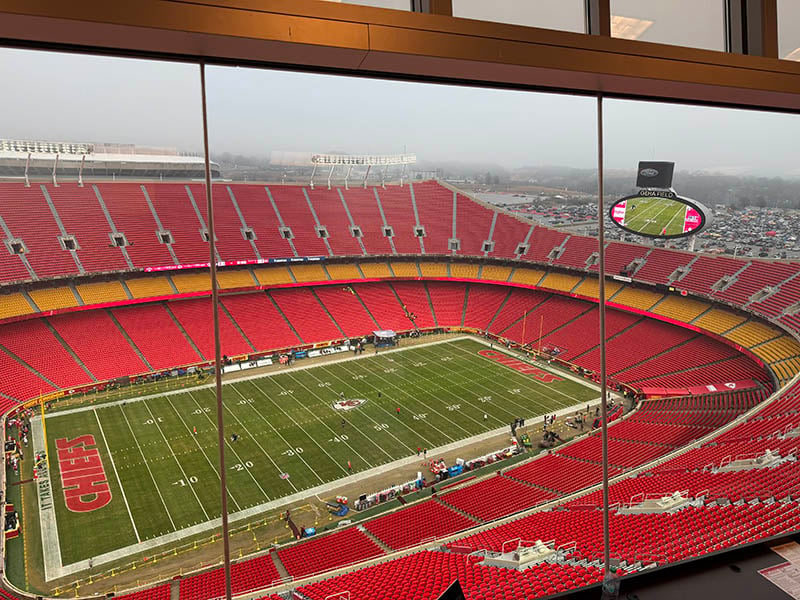
Located in Kansas City, Missouri, Arrowhead Stadium serves chiefly as the home field of the Kansas City Chiefs of the National Football League. Built alongside nearby Kauffman Stadium, where the Kansas City Royals play Major League Baseball, the two venues together make up the Truman Sports Complex. Since opening for the 1972 NFL season, Arrowhead has remained in operation as the oldest stadium in the AFC.
With room for 76,416 spectators, the venue ranks among the largest stadiums in the United States, stands as the fourth-biggest in the NFL, and holds the title of Missouri’s largest sports venue by capacity. A major renovation costing $375 million was finished in 2010, further modernizing the long-standing facility.
The stadium will also play an international role during the 2026 FIFA World Cup, when it is set to host tournament matches under the temporary name Kansas City Stadium to comply with FIFA marketing regulations.
Design, planning, and construction
Work on the project began in 1968, based on an original two-stadium vision created by Denver architect Charles Deaton and Steadman. Although the baseball and football structures were designed with distinct visual identities, they were connected through shared parking, utilities, and underground storage systems.
Early proposals included covered venues, but those plans were ultimately abandoned in favor of open-air stadiums. Lamar Hunt added a private owner’s suite to the football stadium design, featuring bedrooms, bathrooms, a kitchen, and living space.
To maximize seating without greatly expanding the stadium’s overall size, the upper decks were built with an unusually steep slope, a feature that modern accessibility standards would not permit today. Deaton’s plans were later carried out by Kansas City firm Kivett & Myers, while construction itself was handled by the Sharp-Kidde-Webb joint venture.
Architectural legacy and influence
Arrowhead Stadium’s distinctive design has been regarded by some as influential in shaping later NFL venues. Its combination of steep seating sections, large-scale capacity, and integrated complex planning helped distinguish it from many stadiums that followed.
The pairing of two separate sports facilities with shared infrastructure was also a notable feature of the Truman Sports Complex concept. While the football and baseball parks differed significantly in appearance, their coordinated development reflected a broader architectural and logistical strategy.
Today, Arrowhead remains not only a functioning NFL stadium but also a lasting example of late-20th-century sports design.
Top attractions beyond the stadium
Kansas City offers more than football, including the Rabbit hOle in North Kansas City, a vast former tin can factory transformed into a 150,000-square-foot celebration of children’s literature. Created by two former bookstore owners, the imaginative venue explores a century of stories from the 1920s onward, blending nostalgia and literary art in a deeply engaging environment.
Art lovers are drawn to the Nelson-Atkins Museum of Art, the city’s best-known museum, where free admission provides access to collections spanning ancient Egyptian objects, European masterpieces, and Chinese bronzes. Outside, giant badminton shuttlecock sculptures on the lawn have become one of Kansas City’s most recognizable visual symbols.
Union Station, a historic centerpiece dating to 1914, remains both a transportation hub and a cultural destination. Its Beaux-Arts style, towering ceilings, and broad windows make it architecturally impressive, while attractions such as Science City, a planetarium, a model train gallery, and large-format films expand its appeal.
In nearby Independence, the Harry S. Truman Presidential Library and Museum examines the life and presidency of Missouri’s only US president. Following a major renovation completed in 2021, the museum presents exhibits ranging from significant wartime artifacts to memorable pieces of presidential history.