
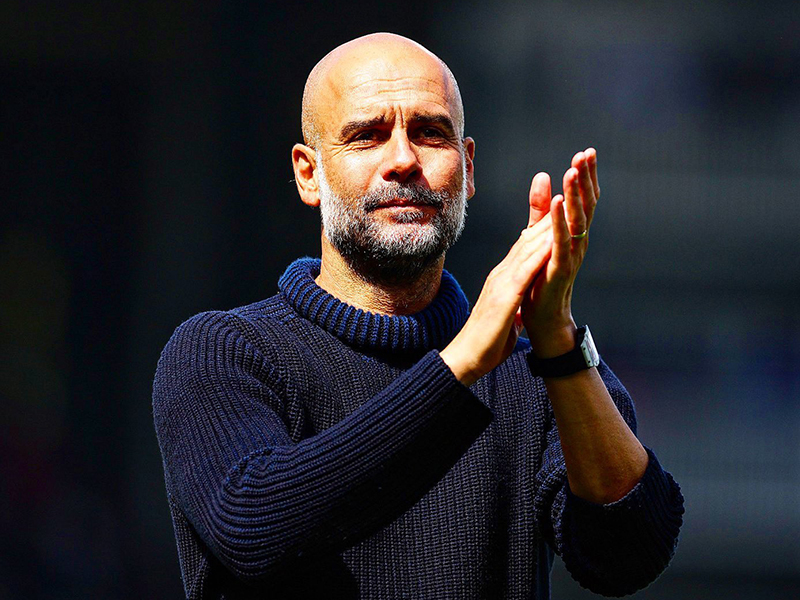
Manchester City’s 2025/26 season has been a story of two arcs: a tough battle to remain at the pinnacle of English football and the looming shadow of Pep Guardiola’s potential departure. After nearly a decade of dominance, reports indicate the Catalan coach could step down this summer, with internal planning already underway for a post-Guardiola era at the Etihad.
Even as City remain locked in a tense Premier League title race with Arsenal and pursue further domestic silverware, the talk on everybody’s lips is Guardiola’s exit. The former Bayern Munich and Barcelona manager’s tenure at Man City was built on tactical control and relentless squad evolution, which helped the team accumulate so many trophies to become one of the most successful dynasties in modern football.
Under his leadership, City has not only redefined English dominance but also constructed a footballing identity that is built upon the foundations of positional control and structural fluidity that has seen lots of adaptations and evolved players.
What comes after Guardiola?
The main concern for City is not whether success has been achieved under Guardiola, but whether it can be sustained without him. He will be leaving with a decade’s worth of system-building, which has created a club where tactical memory is deeply embedded and few players ever struggle to fit in. History also suggests that even the most stable dynasties face turbulence after transformational figures leave.
The immediate challenge will be structural rather than purely managerial. Guardiola’s influence covers matchday decisions, recruitment philosophy, squad shaping, and tactical identity. Replacing that is significantly more complex than replacing a head coach.
Enzo Maresca and the succession debate
Among the leading candidates to take over is Enzo Maresca, a former City assistant who many in the club believe is closest to Guardiola in terms of philosophy. Maresca’s appeal is the possible continuity he brings. His tactical principles mirror City’s under Giardiola, and his coaching journey, which started with Guardiola’s system, suggests a smoother transition than a total overhaul.
However, this supposed continuity can also cause uncertainty because being able to replicate structure does not guarantee being able to command the same authority that Guardiola did, especially at a club with such high standards. Guardiola’s success was not just in maintaining standards but in reinventing them across cycles.
Any successor will be judged against that capacity for reinvention. The key question is whether Maresca can evolve the system rather than just inherit it. If Guardiola does leave this summer, Manchester City will not simply be losing a manager. They will be closing the chapter on an era defined by control, innovation, and sustained dominance.
The real test for Maresca or any other manager who replaces Guardiola will be how they can transition the current face of the club from being a Guardiola project to a self-sustaining institution. While Maresca represents the closest thing to continuity, continuity alone may not be enough to preserve a dynasty that was built on constant evolution.