
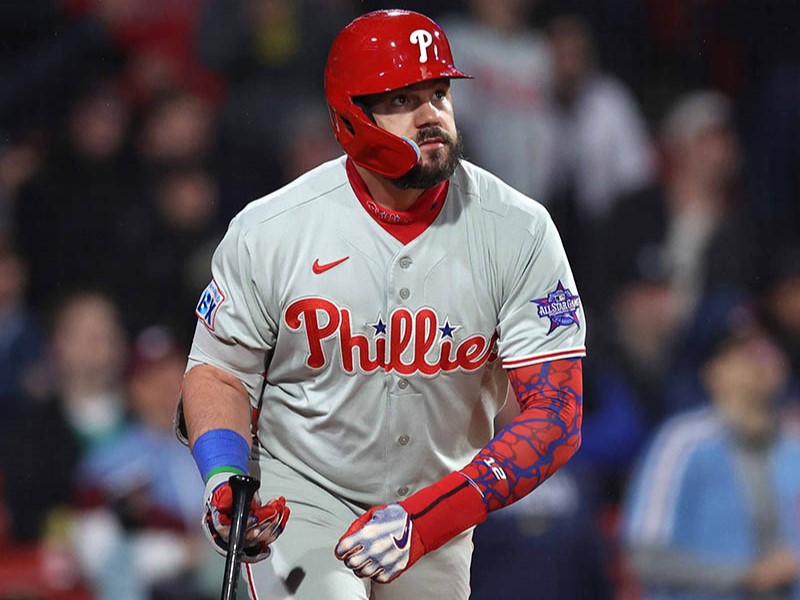
Kyle Schwarber recalled arriving in the Boston clubhouse in 2021 after being traded while injured with a strained hamstring, an experience that left him unsure how teammates would react. At that point, Boston had brought him in despite knowing he could not contribute immediately, as he was coming off a stretch in Washington where he had hit 25 home runs in 72 games during a season in which his team was sliding toward the bottom of the standings.
He described the moment as feeling like “the first day of school,” aware that joining an already strong roster created uncertainty around his presence. Boston’s group included established figures such as Xander Bogaerts and J.D. Martinez and Schwarber admitted he wondered how he would be received upon arrival.
Inside that environment, he quickly connected through Kevin Plawecki, a familiar collegiate opponent from earlier years, and followed advice from hitting coach Kevin Long to introduce himself. That small interaction became a doorway into a clubhouse where Schwarber would soon gain acceptance.
Rebuilding a reputation after setbacks
Schwarber’s path included moments of instability that shaped how others now view him. After a difficult 2020 campaign in which he posted a .188/.308/.393 line over 59 games in the shortened season, the Chicago Cubs decided to move on from him, a decision made by president of baseball operations Jed Hoyer after previously drafting him and seeing him contribute to a championship run.
He had also experienced injury setbacks, time in the minors, and a non-tender decision that left his future uncertain, even after early postseason success and high expectations as a former first-round pick. These fluctuations became part of his identity within the sport rather than defining his end.
Teammates like Bryce Harper later pointed to that journey as central to Schwarber’s presence in the game, noting how he had moved through highs and lows before returning as a dominant force. The accumulation of those experiences, rather than a single breakout moment, shaped how he interacts with teammates across different stages of their careers.
Presence that resonates inside every clubhouse
Across multiple teams, Schwarber has developed a reputation that extends beyond his performance at the plate. From Chicago to Boston and now Philadelphia, he has been embraced by fanbases and teammates alike, even receiving warm reactions from Boston supporters years after his time there ended.
Former teammate Kevin Plawecki described him as a “special individual,” emphasizing that his character becomes clear only after being around him directly. In Philadelphia, younger players such as Justin Crawford have credited Schwarber with helping them adjust to the daily rhythm and emotional swings of a long season.
Even established stars like Bryce Harper have spoken about his impact, describing him as one of the most valued teammates he has played alongside. Schwarber’s ability to relate to players at different stages—rookies trying to settle in, veterans seeking consistency, and stars managing expectations—has made him a stabilizing presence rather than just a power hitter.
Phillies power surge and record chase
On the field, Schwarber continues to produce at a historic pace with Philadelphia, adding to his reputation as one of baseball’s most dangerous hitters. He delivered multiple home runs in a series at Fenway Park, including a go-ahead shot late in a scoreless game that helped secure a series win.
Through his first five seasons with the Phillies, he has accumulated 205 home runs, placing him sixth on the all-time list for most homers by a player in that span with a single franchise. The list is topped by Babe Ruth, followed by names such as Mark McGwire, Ralph Kiner, David Ortiz, and Alex Rodriguez, with Schwarber still climbing.
Over his five seasons in Philadelphia, he has already become one of the most productive power hitters in the sport, with numbers that keep him within reach of long-standing records.
Approach to hitting and steady mentality
Despite his reputation for power, Schwarber has repeatedly expressed that he never set out to become a three-outcome hitter defined by home runs, walks, and strikeouts. He has said he values hitting for average as well, recalling frustration when early professional seasons did not match the batting success he once had.
He has also reflected on uneven statistical years, describing how low batting averages during certain seasons bothered him because he identifies primarily as a baseball player rather than a one-dimensional slugger. Still, he has continued to operate within his strengths, ultimately finding a role that allows him to dominate games in his own way.
Even during periods of managerial change and early-season inconsistency for the Phillies, Schwarber projected calm belief in the group, expressing confidence that the team would stabilize. That steady tone mirrored the role he has come to play: not just as a source of power, but as a voice that helps settle those around him during turbulent stretches.