
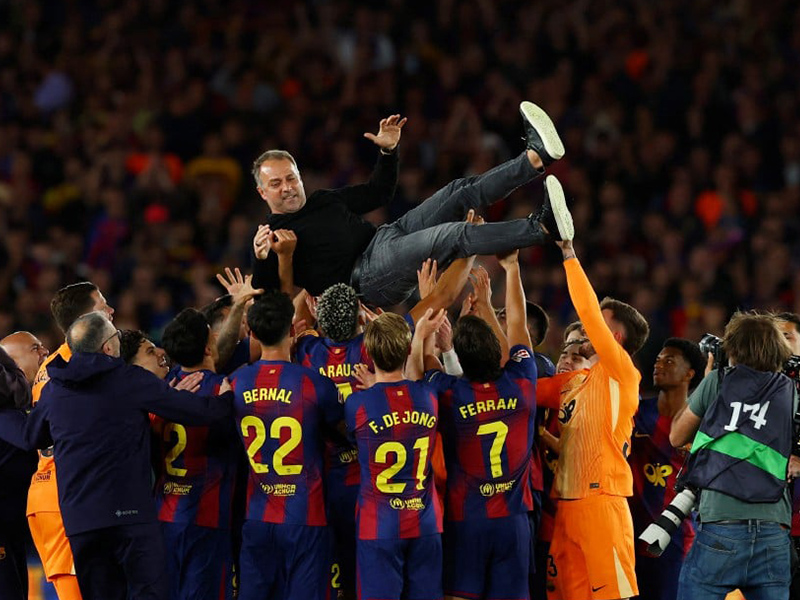
Barcelona are La Liga champions for the 29th time in their history, defying the odds to claim the title from what was very much a losing position at the turn of the year. Hansi Flick has not only stabilised the club as he was brought in to do but has also constructed a new domestic powerhouse capable of braving the odds against the club’s financial limitations and the looming threat of a Real Madrid led by the indomitable Kylian Mbappé.
But Barcelona’s second consecutive LaLiga title under Flick was far from being a walk in the park. They dealt with injuries in key periods of the campaign, which affected their already thin squad. Still, they tried and succeeded to be the league’s most consistent and tactically coherent side, and their reward was a Clasico victory over Real Madrid to seal the title. There is nothing sweeter than winning the title on the heads of your archenemies, after all.
This achievement is even more remarkable when you consider the fact that Mbappé’s arrival at Real Madrid was seen as the beginning of another Madrid-controlled era, especially with Barcelona’s financial restrictions that limited marquee recruitment. Atlético de Madrid also invested heavily, while several mid-table clubs improved squad quality significantly. Instead of competing financially, Flick rebuilt Barcelona into arguably Europe’s most aggressive attacking unit, combining a high defensive line with relentless vertical football.
How Flick neutralised the Mbappé threat
After Mbappé failed to win the league in his first season, many pointed to the goals he scored as a foundation for his and Madrid’s future dominance. The Frenchman broke so many scoring records last season that it seemed inevitable that he would not only repeat the feat but also become the catalyst for a dominant run. This was not the case, as Flick’s Barcelona repeatedly exposed Madrid’s instability through tactical discipline and collective balance.
Flick’s Barcelona has defeated Real Madrid multiple times across competitions during his tenure so far, doing so with young players and without compromising competitiveness. Lamine Yamal continued his rise into global superstardom, while Pedri, Cubarsí, Balde, and other academy-driven talents became central to a title-winning core, outshining Mbappé and other big names in Los Blancos’ squad.
Can Barcelona sustain this dominance?
The bigger question now is sustainability. Barcelona’s lack of experienced squad depth remains a genuine concern, particularly across defense and midfield. Also, Flick’s tactical model is physically demanding. It requires relentless pressing, positional discipline, and high-intensity transitions.
Doing this over two seasons has taken a toll on the bodies of his first-team squad members, most notably Jules Kounde, Raphinha, and Lamine Yamal. Clubs also started to evolve their playing style to adapt to Flick’s system, and they will continue to adapt to Flick’s aggressive approach as time goes on.
This includes their archenemies Real Madrid, who are unlikely to remain structurally inconsistent forever. Mbappé’s presence alone guarantees Madrid remains a long-term threat capable of reshaping the balance quickly. A more stable coaching core and a few squad additions here and there could easily tilt things back in their favour.
For now, Barcelona’s greatest strength is the clarity of their footballing vision, and Flick has shown that tactical conviction and collective identity can still overcome individual star power.