
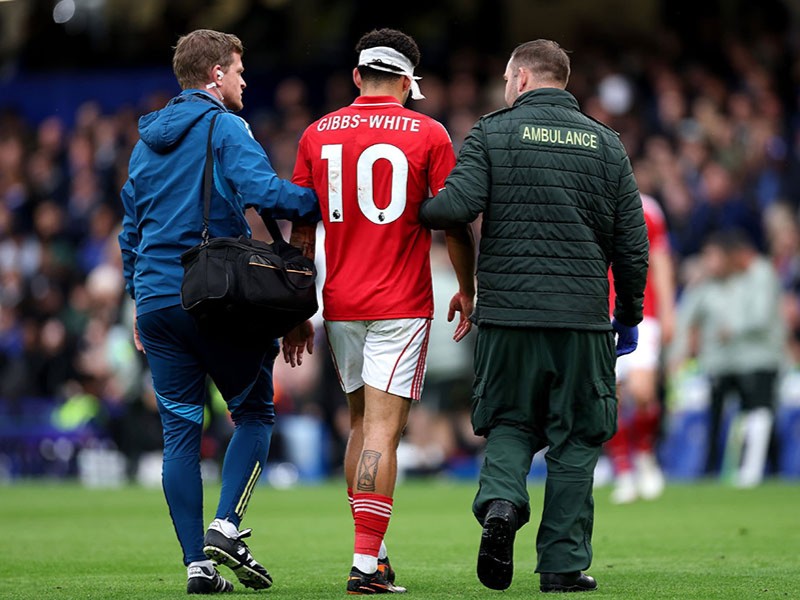
Nottingham Forest boss Vitor Pereira admits Morgan Gibbs-White may require something close to a “miracle” to feature in Thursday’s Europa League semi-final second leg against Aston Villa after suffering a serious facial wound during Monday’s 3-1 Premier League victory over Chelsea.
The England midfielder was left bloodied following a heavy clash with Chelsea goalkeeper Robert Sanchez at Stamford Bridge, with both players needing treatment and bandages before being withdrawn. Forest heads into the return leg at Villa Park holding a slender 1-0 advantage, but Gibbs-White’s involvement remains in doubt because of the extent of the cut.
Pereira described the injury as a deep gash but remained cautiously optimistic, stressing the player’s determination could yet help him recover in time. The Forest manager even joked that if Gibbs-White is available, he may need to avoid using his head during the game.
Social media updates reveal extent of damage for both players
After the match, Gibbs-White shared an image online showing stitches running across his forehead and nose while thanking supporters for their concern. Sanchez also posted his own photograph displaying stitches on his scalp and sent a message of support to his opponent, acknowledging that Gibbs-White appeared to have suffered the worse injury.
The incident was one of two significant head collisions during the match, highlighting the physical toll of the contest. Despite the alarming nature of the impact, Pereira confirmed Gibbs-White was not removed because of concussion concerns.
That distinction could prove crucial, as it means the midfielder does not automatically fall under football’s formal concussion recovery procedures and could return as soon as his wound is considered sufficiently healed.
Concussion rules avoided, offering Forest hope
Because Gibbs-White was not diagnosed with concussion, he is not bound by the mandatory step-by-step protocols that would almost certainly have ruled him out of the Villa clash. Under those measures, players must initially avoid activity for at least 24 hours, complete 48 hours of rest, and then progress through a six-stage process before being cleared.
Premier League regulations allow each side one permanent concussion substitute that does not count toward standard substitution allowances. Chelsea used that option earlier in the same fixture when 18-year-old debutant Jesse Derry was forced off after a separate collision with Forest defender Zach Abbott.
Derry was taken to the hospital following the incident, though Chelsea later confirmed he was conscious, speaking, and receiving a precautionary medical assessment.
Headway calls for stronger safeguards after multiple incidents
Brain injury charity Headway commended the immediate response shown to Derry and Abbott but argued that the later collision involving Gibbs-White and Sanchez exposed wider shortcomings in football’s current safety framework.
Chief executive Luke Griggs said while concussion substitutions are a positive measure, limiting teams to one such change per match can leave clubs restricted when further head injuries arise. He also reiterated criticism of the game’s refusal to introduce temporary concussion replacements.
Griggs suggested scrutiny would inevitably follow over why Gibbs-White and Sanchez were not placed under mandatory return-to-play procedures, though he emphasized responsibility lies not with the clubs’ medical teams but with the laws governing player welfare.