
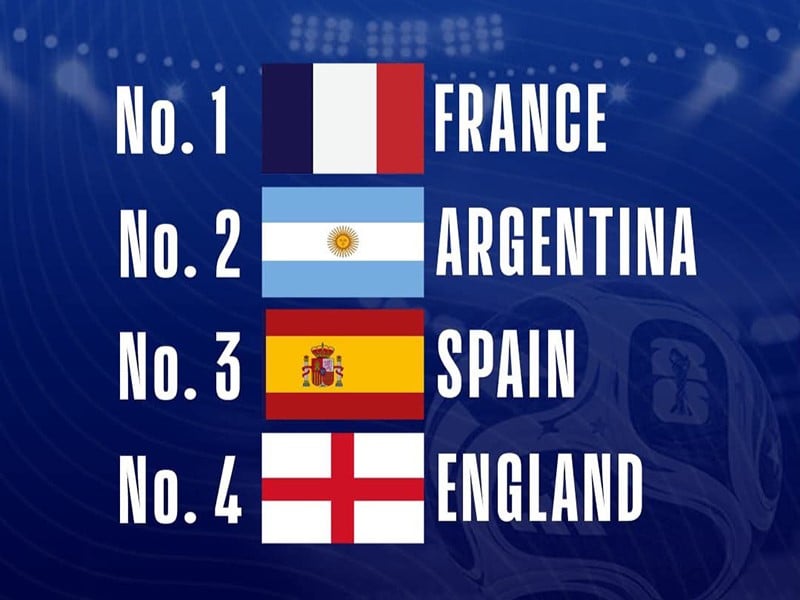
For the first time since the introduction of FIFA’s world rankings, the four highest-ranked national teams have all progressed to the semi-finals of a World Cup. Spain, Argentina, France, and England each topped their respective groups, allowing the tournament bracket to unfold exactly as designed.
The structure introduced for the 2026 edition ensured that the leading four teams in the rankings were placed in separate sections of the knockout draw. As a result, none of them could face one another before the last four, provided they finished first in their groups.
That sequence of results has produced two heavyweight semi-final encounters. France will meet Spain on Tuesday, while England is set to play Argentina on Wednesday.
The new draw format shapes the knockout bracket
The revised system also guaranteed that Spain and Argentina could only meet in the final if both continued winning. England and France, meanwhile, were positioned on opposite sides of the knockout stage, leaving each on course for a possible semi-final against either Spain or Argentina.
Fifa said the adjustment was made to maintain “competitive balance” by creating two independent routes to the semi-finals. The governing body publicly explained the change before the tournament, making clear that its aim was to avoid the leading-ranked nations eliminating one another too early.
Comparable seeding principles are used in other major competitions, including Wimbledon and the revamped Champions League, where top seeds are deliberately separated in the draw.
Why FIFA introduced the adjustment
Under the previous 32-team World Cup format, group winners were already protected from meeting in the round of 16. Encounters between the world’s top four-ranked sides before the semi-finals were therefore uncommon, with the 2010 quarter-final between the Netherlands and Brazil standing as the most recent example.
The expansion to a 48-team competition introduced an additional knockout round, making clashes between group winners much more likely in the early stages. During this tournament’s last 16, the United States played Belgium, England faced Mexico, and Switzerland took on Colombia.
Because of that expanded format, Fifa decided an alteration was necessary to reduce the possibility of marquee fixtures taking place before the semi-finals and to lessen the risk of one of the four highest-ranked teams being eliminated earlier than intended.
Previous tournaments followed a different pattern
Although FIFA rankings were launched in 1994, they were not used for that year’s World Cup. In later tournaments, several nations ranked among the world’s top four failed to even progress beyond the group stage.
Belgium in 2022, Germany in 2018, Spain in 2014, Italy in 2010, and France in 2002 all exited the competition before the knockout rounds despite being inside the top four of the rankings.
The governing body’s approach had already been applied during last year’s Club World Cup, where only one of the four leading seeds, Real Madrid, reached the semi-finals. At this World Cup, however, the revised draw has produced the outcome FIFA had intended.