
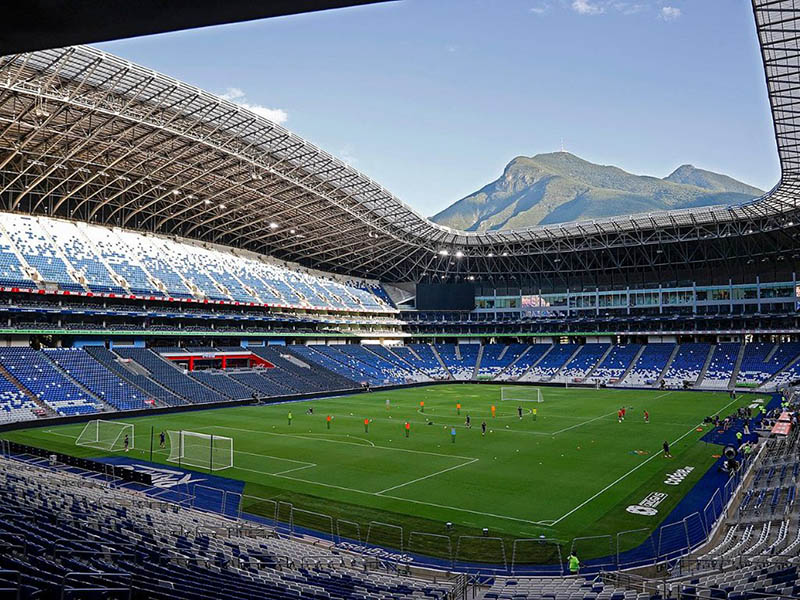
Estadio BBVA, previously called Estadio BBVA Bancomer, stands in Guadalupe within the Greater Monterrey area of Nuevo León. Known by the nickname “El Gigante de Acero,” the venue became the new home of C.F. Monterrey after replacing Estadio Tecnológico, where the club had played for 63 years. The stadium carries the branding of the Spanish banking group BBVA and its Mexican division BBVA Mexico.
The arena officially opened on 2 August 2015 during the eighth edition of the Eusébio Cup. In that inaugural match, Monterrey secured a 3–0 victory over S.L. Benfica. The venue is also expected to stage matches during the 2026 FIFA World Cup.
Architecture and sustainable design
The project was developed by FEMSA, owner of Monterrey, while the architectural concept was created by the international firm Populous together with the Mexican studio VFO. Federico Velasco and Populous led the design process. Building work started in August 2011 and concluded in July 2015.
When the stadium first opened, it accommodated 51,000 spectators, ranking it as the fourth-largest football stadium in Mexico. Constructed at a cost of US$200 million, it became the country’s most expensive stadium at the time. In 2016, additional seating increased the capacity to 53,500 people.
The venue features a natural grass pitch, luxury suites, a themed restaurant connected to the club, and premium interior and exterior finishes. With a grandstand inclination of 34 degrees and the minimum FIFA-approved distance between spectators and the field, fans are placed close to the action during matches.
The stadium also earned silver certification from Leadership in Energy and Environmental Design for its environmentally conscious planning. It became the first football venue in North America to receive that distinction.
Green areas and mountain scenery
More than one-third of the stadium grounds consist of landscaped green zones, surpassing existing regulatory requirements. These permeable spaces help filter rainwater and support aquifer replenishment. Parking areas were arranged throughout the complex alongside wooded sections in order to integrate the structure with the surrounding ecological park.
One of the most recognizable aspects of the stadium is the view toward Cerro de la Silla, the famous mountain whose highest summit reaches 1,820 meters. Spectators seated in the northwestern part of the arena can enjoy panoramic views of the landmark while attending events.
Main attractions of Nuevo León
Macroplaza and Paseo Santa Lucía
Macroplaza is among the most visited destinations in Nuevo León. Situated in central Monterrey, the public square covers more than 40 hectares and is considered one of the world’s largest plazas. The area includes monuments, museums, gardens, fountains, and notable buildings connected to the city’s history and culture.
Another prominent attraction is Paseo Santa Lucía, a pedestrian promenade centered around an artificial canal stretching roughly 2.5 kilometers. Bridges, murals, landscaped areas, and fountains line the route, making it a popular location for both residents and tourists.
Boat rides along the canal provide visitors with a different perspective of Monterrey’s urban scenery, while the walkways surrounding the waterway create an inviting setting for exploration and photography.
Fundidora Park and the Bishopric viewpoint
Fundidora Park combines recreation, culture, entertainment, and industrial heritage within a single urban space. Built on the former grounds of Fundidora de Acero, the park has become one of the most significant tourism sites in Monterrey.
More than 150 original structures from the former steel plant remain preserved inside the complex and are regarded as part of the city’s industrial archaeological heritage. Among the most important features is the Horno 3 Steel Museum, a restored blast furnace transformed into an interactive museum focused on Monterrey’s industrial development.
Another major destination is the Mirador del Obispado, located on Cerro del Obispado. The site offers sweeping views across the city and is home to the Monumental Flagpole, recognized as one of northern Mexico’s defining symbols.
The same area also contains the Regional Museum of Nuevo León El Obispado, a historic colonial-era structure featuring a central courtyard and an oratory decorated with Churrigueresque elements. Through its exhibits, visitors can explore the historical development of Monterrey and Nuevo León.