
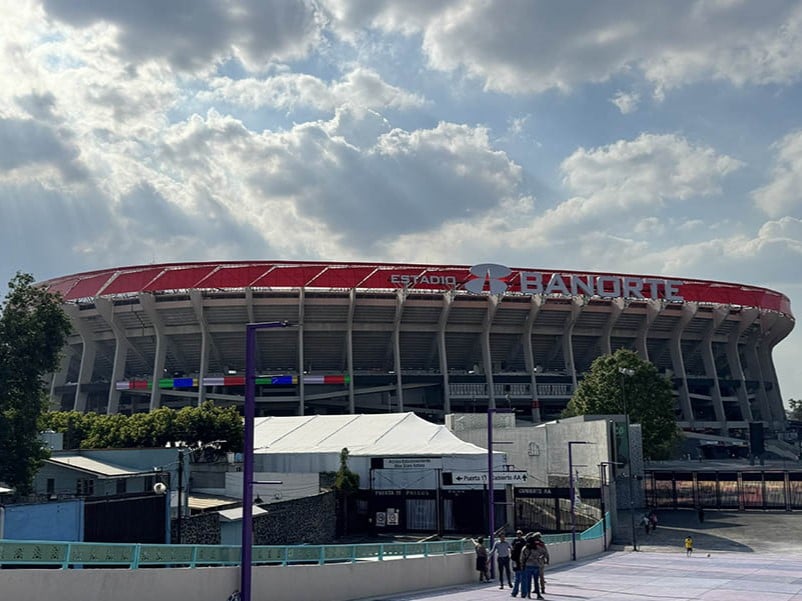
Estadio Azteca, officially known for sponsorship purposes as Estadio Banorte, stands in the Coyoacán district of Mexico City and serves as the home ground of Club América and the Mexico national team. Located 2,200 meters above sea level, the venue holds 87,523 spectators, making it the biggest stadium in Latin America and one of the largest football arenas on the planet.
The stadium is widely recognized as one of world football’s most iconic venues. It became the first ground ever to stage two FIFA World Cup finals. In 1970, Brazil defeated Italy 4–1 there, while in 1986 Argentina overcame West Germany 3–2. The arena also welcomed the unforgettable quarter-final between Argentina and England in 1986, where Diego Maradona scored both the “Hand of God” goal and the celebrated “Goal of the Century.”
The venue occupies a unique place in football history because both Pelé and Diego Maradona lifted the World Cup trophy there. Pelé celebrated Brazil’s triumph in 1970 with the Jules Rimet Trophy, while Maradona raised the modern FIFA World Cup Trophy in 1986. Another historic encounter at the stadium was the famous “Game of the Century,” when Italy defeated West Germany 4–3 after extra time in the 1970 semi-finals.
Beyond World Cup matches, the arena hosted the football tournament during the 1968 Summer Olympics and welcomed the 1971 Women’s World Cup. It is also set to stage matches during the 2026 FIFA World Cup, including the opening game between South Africa and Mexico, which will make it the only stadium to host three editions of the tournament.
From ambitious project to national symbol
The construction of the stadium began during the presidency of Adolfo López Mateos after Mexico received hosting rights for the 1968 Olympic Games. Architects Pedro Ramírez Vázquez and Rafael Mijares Alcérreca designed the massive project, and work officially started in 1961.
The opening match took place on 29 May 1966 between Club América and Torino F.C. At that time, the venue could accommodate 107,494 fans. Only a few days later, on 5 June 1966, a modern lighting system was introduced, and the first night match featured Valencia C.F. against Necaxa.
Over the decades, the stadium experienced several modernization projects. Seating areas were replaced, while electronic advertising systems were gradually added. In May 2015, Panasonic LED screens were installed at both ends of the venue, replacing the older phosphorous panels that had been in place since 1998.
The stadium also became a home for memorials dedicated to historic football moments. Bronze plaques commemorate both the “Game of the Century” and Maradona’s “Goal of the Century.” Another plaque honors the scorers of the first goal during the inaugural match and the first goal scored under the stadium lights.
Record crowds and unforgettable sporting moments
The stadium has witnessed enormous attendance across different sports. In 1993, 132,000 spectators filled the arena to watch Julio Cesar Chavez defeat Greg Haugen by technical knockout. The attendance remains the second-largest crowd ever recorded for a boxing match.
Mexico also produced memorable football victories there. Before facing Brazil at the stadium in 1968, the national team had failed to beat the South Americans in eight meetings. At the Azteca, however, Enrique Borja scored twice in a 2–1 victory over a Brazilian side featuring stars such as Carlos Alberto, Gerson, Rivelino, Jairzinho, and Tostao.
Another famous triumph arrived in 1999, when a Cuauhtemoc Blanco-inspired Mexico defeated Ronaldinho’s Brazil in the FIFA Confederations Cup final. The venue also hosted the 1983 FIFA U-20 World Cup final, where 110,000 spectators watched Brazil defeat Argentina with players such as Jorginho, Dunga, and Bebeto playing major roles.
The stadium’s international importance is reflected in the range of competitions held there. It remains the only venue to have staged the FIFA World Cup, FIFA U-20 World Cup, FIFA U-17 World Cup, and the Confederations Cup. In 1971, Denmark won the Female Football Championship there, a tournament considered a precursor to the FIFA Women’s World Cup.
Discovering the culture around the stadium
Mexico City offers several cultural attractions close to the famous arena. Casa Azul, the longtime home of artist Frida Kahlo, preserves her paintings, family photographs, and personal belongings inside the striking blue residence. Visitors can also see objects connected to the hardships and injuries that shaped much of her life.
South of the capital lies Xochimilco, an area created from ancient canal systems and agricultural islands built by the Aztecs centuries ago. Today, the canals are famous for colorful trajinera boats, lively gatherings, and mariachi music that attract both residents and travelers during weekends.
Another major destination near the city is Teotihuacán, once among the largest urban centers in the Americas. The ancient settlement, abandoned centuries ago, still fascinates visitors with the Avenue of the Dead, the Pyramid of the Sun, and the Pyramid of the Moon. Some travelers even explore the site from above in hot air balloons.
To better understand the country’s pre-Columbian heritage, many visitors head to Museo Nacional de Antropología. The museum contains around 600,000 artifacts spread across 23 exhibition halls, including the renowned Aztec sunstone and the giant Olmec stone heads.