
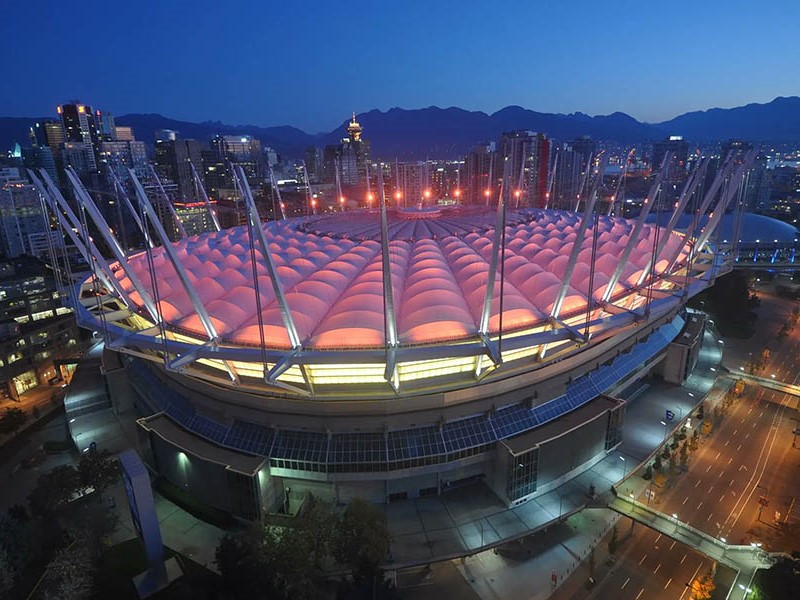
BC Place is a multi-purpose stadium situated on the northern side of False Creek in Vancouver, British Columbia. The facility belongs to the BC Pavilion Corporation (PavCo), a Crown corporation operated by the province. Since opening on June 19, 1983, the venue has become one of the most recognizable sports and entertainment sites in Canada.
The stadium was constructed as part of preparations for Expo 86, the 1986 World’s Fair held in Vancouver. Structural engineers from Geiger Berger Associates designed the original building with an air-supported roof that was considered the largest of its kind in the world at the time. The design resembled the Hubert H. Humphrey Metrodome in Minneapolis, Minnesota, and remained a landmark feature for decades.
Today, BC Place serves as the home stadium for the BC Lions of the Canadian Football League and Vancouver Whitecaps FC of Major League Soccer. The venue also hosts the annual Canada Sevens tournament and houses the BC Sports Hall of Fame. Over the years, it has welcomed major international sporting events and large crowds for football and soccer matches.
The stadium played a central role during the 2010 Winter Olympics and Paralympics, later hosting the 2012 CONCACAF Women’s Olympic Qualifying Tournament and several matches at the 2015 FIFA Women’s World Cup, including the final. BC Place is also scheduled to stage multiple games during the 2026 FIFA World Cup, among them knockout-round fixtures.
Major renovation and modern upgrades
In May 2008, officials confirmed that BC Place would undergo an extensive modernization project worth more than $150 million. The renovation work was divided into two phases and became one of the largest redevelopment projects ever completed at the stadium.
A key element of the reconstruction was the replacement of the original inflatable roof. Following the 2010 Winter Olympics, the building closed for 16 months so crews could install a retractable roof supported by cables. After completion, the new structure became the largest retractable roof of its kind.
The renewed venue also received a centre-hung high-definition scoreboard that ranks as the second largest in North America behind the display at AT&T Stadium. In addition, a new artificial playing surface produced by Polytan was installed at a reported cost of $1.2 million. The pitch was designed to meet FIFA 2-star certification standards and measures 117 by 75 yards.
After Vancouver Whitecaps FC entered MLS and relocated to the updated stadium, the club initially used only the lower seating bowl for league matches. In 2018, the team attracted 27,683 supporters for a regular season meeting with Seattle Sounders FC without opening the upper level. Several years later, on November 22, 2025, the Whitecaps established a new MLS attendance record for the club when 53,957 fans watched the playoff semifinal against Los Angeles FC.
Stanley Park and Vancouver Island highlights
Among the best-known destinations in British Columbia is Stanley Park, a 1,000-acre green space located beside downtown Vancouver. The park offers views of the city skyline, surrounding mountains, and the Pacific Ocean. Visitors can explore forest paths, cycle or walk the 9-kilometre Seawall, spend time at the Vancouver Aquarium, or relax near the waterfront beaches.
One of the park’s most photographed landmarks is the collection of totem poles at Brockton Point. The area remains a popular stop for travelers wanting to experience nature while staying close to the city centre.
On Vancouver Island, the Inner Harbour in Victoria stands out as one of the province’s most picturesque waterfront areas. Tourists can watch floatplanes depart from the harbour, visit the Royal BC Museum, admire the Fairmont Empress Hotel, or join whale-watching excursions departing from the docks. During summer, the harbour becomes especially lively with musicians, street performers, and outdoor cafés.
Another major attraction on Vancouver Island is Pacific Rim National Park Reserve on the island’s west coast. The park is known for its dramatic shoreline, ancient rainforests, and outdoor activities. Travelers can walk along Long Beach near Tofino, kayak through the Broken Group Islands, or visit the area for surfing and storm watching.
Mountain resorts, gardens and remote islands
Whistler Blackcomb is internationally recognized as one of British Columbia’s leading ski destinations. The resort attracts visitors throughout the year, offering skiing and snowboarding across more than 8,000 acres during winter months. In warmer seasons, guests can explore alpine hiking routes, mountain biking trails, and the Peak 2 Peak Gondola, which provides panoramic mountain views.
Near Victoria, Butchart Gardens remains one of the province’s most celebrated attractions and holds status as a National Historic Site of Canada. Spread across 55 acres, the gardens include floral displays, fountains, themed landscapes, and walking paths.
Among the most visited sections are the Sunken Garden and the Japanese Garden. During summer evenings, the site also features entertainment events and fireworks displays that attract large numbers of visitors.
Farther north, Haida Gwaii offers a more remote experience shaped by Indigenous culture and natural scenery. Previously known as the Queen Charlotte Islands, the archipelago is home to Gwaii Haanas National Park Reserve, where visitors can see historic Haida totem poles and longhouses.
The islands are also known for fishing, hiking opportunities, and wildlife viewing. Their isolated location and cultural significance make Haida Gwaii one of the most distinctive destinations in British Columbia.