
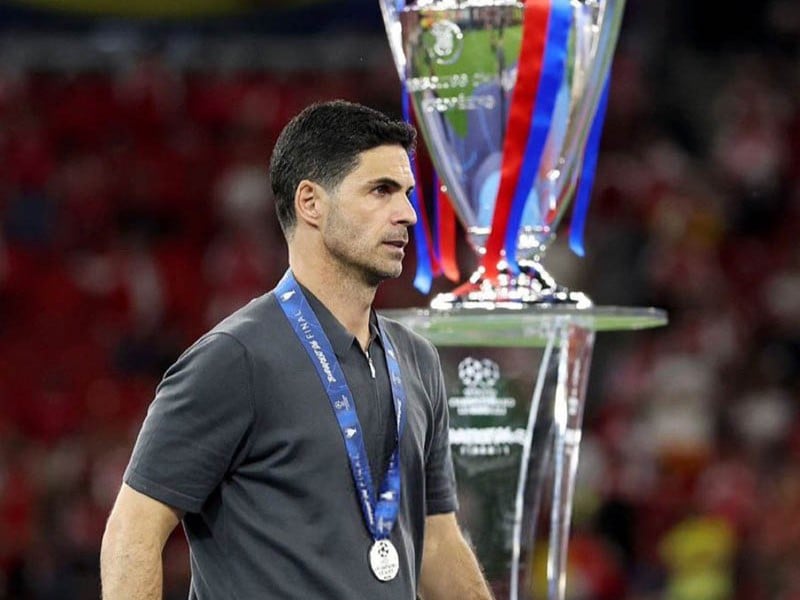
Arsenal went into the 2025/26 UEFA Champions League final with so much promise. For most of the campaign, they looked like a complete European side. They topped the league phase with eight wins from eight matches, eliminated strong opponents, and built their run on balance, intensity, and control.
Yet, in their final against Paris Saint-Germain, they looked like a very different side, contradictory to the kind of displays they showed on the way to the final. Arsenal reached the biggest game in Europe but abandoned many of the principles that got them there. After taking an early lead, they retreated into a defensive formation, surrendered possession, and struggled to threaten PSG consistently. Their performance was overly cautious, and they produced little attacking pressure despite the quality in their squad.
The result was not simply a penalty-shootout defeat. It was a reminder that winning the Champions League requires more than surviving matches.
Arsenal must make the following changes to be able to maintain the same level that they showed on their way to the final.
Add another elite ball carrier
Arsenal remains heavily dependent on Bukayo Saka and Martin Ødegaard for progression through pressure. Once in a while, Declan Rice carries, but outside of these three, they do not have an established ball carrier.
That is why links to Morgan Rogers make tactical sense. Rogers is powerful in transition, comfortable receiving between lines and capable of operating from either wing or as a central attacking midfielder. Reports suggest Arsenal are pushing hard for the Aston Villa star.
Against elite European opponents, Arsenal often need another player who can break defensive structures without relying on intricate passing sequences.
Find a different gear in possession
The final highlighted Arsenal’s biggest weakness: they can become predictable when made to sit deep.
PSG dictated the entirety of the match after Arsenal’s early lead. And while Arsenal’s defensive organisation was excellent, their decision to not retain possession and their inability to retain it when gifted invited continuous pressure from Luis Enrique’s pressing machines.
Arteta’s next evolution must be building a side capable of controlling games through the ball, not merely through structure.
Increase attacking depth
The gap between Arsenal’s first-choice attackers and their alternatives is very noticeable.
Whether with Rogers or another elite forward, Arsenal need more unpredictability from the left side and more goals from wide areas. Too often in Europe, Saka becomes the primary attacking reference point.
Add midfield variety
Arsenal’s midfield is outstanding defensively and can hold its own creatively to an extent, but it still lacks a true chaos creator and controller.
PSG’s best moments came from players willing to take risks between the lines. Arsenal, on the other hand, have prioritised control over invention in their matches. Reports linking the club with technically gifted midfielders suggest Arteta recognises the issue.
Trust the team’s identity in big games
This may be the most important change.
Arsenal’s league-phase performances and knockout victories were built on very proactive football where they took the game to their opponents. In the final, they became reactive, waiting for PSG to slip up. The contrast was stark because they had played more confidently in several earlier Champions League matches than they did in Budapest.
The best Champions League winners always impose themselves on their opponents. Arsenal proved throughout the campaign that they can do exactly that, but for some reason, they did not believe it when it mattered most.