
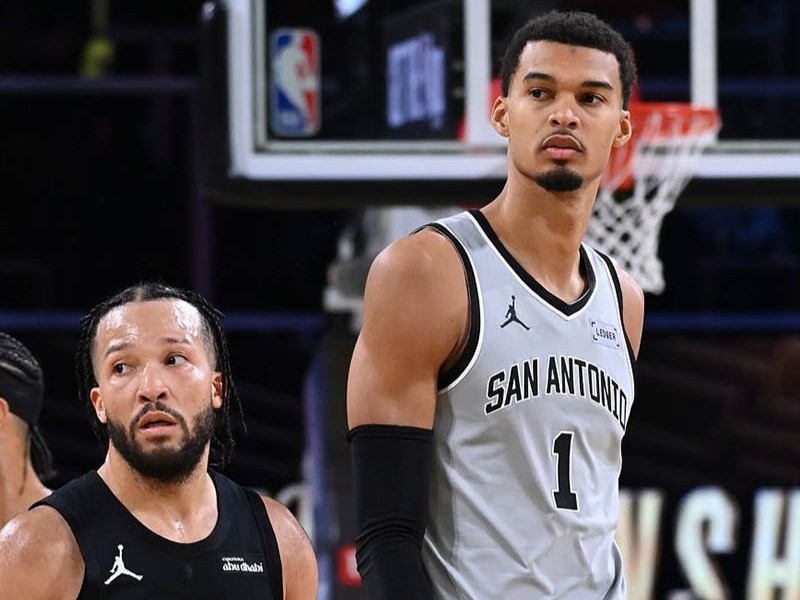
The 2026 NBA Finals are locked in after San Antonio eliminated the defending champion Oklahoma City Thunder in a Game 7 win during the Western Conference Finals. That victory sends the Spurs back to the championship stage for the first time since 2014, where they will meet the New York Knicks, who powered through the Eastern Conference with a dominant run.
The series also revives a historical connection between the two franchises. The last time the Knicks reached the Finals was in 1999, when they were beaten in five games by San Antonio. That Spurs team went on to begin a run of five titles in 15 years, led by Tim Duncan.
This time, the spotlight shifts to Victor Wembanyama, the 22-year-old centerpiece of the Spurs. He becomes the youngest player ever to make an All-NBA First Team and reach the Finals in the same season. On the other side, Jalen Brunson leads a Knicks team aiming to end a championship drought that stretches back to 1973.
With Game 1 approaching on Wednesday and the series potentially lasting 17 days if it goes the distance, attention now turns to the key factors that could determine the outcome.
Mitchell Robinson’s availability and impact inside the paint
One of the biggest uncertainties for New York is the condition of Mitchell Robinson, who suffered a broken pinky on his right hand shortly before the Finals. He has already undergone surgery, and while there is hope he will be able to play, his availability remains unclear ahead of Game 1.
Even if he is cleared to suit up, his effectiveness is expected to be affected. Robinson is not a high-scoring player, averaging 5.5 points and 5.3 rebounds in the playoffs, but his value comes from his physical presence and elite offensive rebounding.
New York’s performance on the glass changes significantly depending on whether he is on the court. With him playing, their offensive rebounding rate in the postseason is 39.4%, but it drops to 28.6% when he is off the floor. That difference also connects to second-chance production, where the Knicks lead all playoff teams with 17.7 points per game.
The depth behind him is limited. Ariel Hukporti is the only other traditional center available, but he has played only 79 NBA games and has been used almost entirely in low-pressure minutes during this postseason. That forces the Knicks into a difficult rotation decision if Robinson is unable to handle a normal workload.
How much Robinson can contribute—especially against a Spurs front line anchored by Wembanyama—could heavily influence New York’s ability to compete physically throughout the series.
Perimeter shooting as the Knicks’ offensive lifeline
San Antonio’s defense, led by Victor Wembanyama, is expected to reshape how New York scores. His ability to protect the rim has already disrupted opposing offenses throughout the playoffs, forcing teams away from the basket and into tougher shot selection.
Opponents have struggled to finish inside when he is on the floor, and even elite drives have been altered by his defensive range and timing. In one late-game moment against Oklahoma City, his presence alone forced a difficult pass out of the paint despite the Thunder having a potential driving lane.
That interior resistance matters because New York’s offense has been strongest near the rim. The Knicks lead all playoff teams in attempts inside the restricted area at 29.6 per game, while converting those looks at 68.1%. They also top the postseason in paint scoring at 53.3 points per game and maintain a strong free-throw rate.
However, success inside the arc may not translate as easily against San Antonio’s rim protection. As a result, New York’s outside shooting becomes even more important to its title hopes.
The Knicks have been highly effective from deep throughout the playoffs, hitting at least 10 three-pointers in 12 of 14 games and shooting 40% from beyond the arc, the best mark among all teams. Seven different players attempt multiple threes per game, showing how evenly distributed their perimeter threat is.
Whether that shooting efficiency can hold against a defense built around Wembanyama’s deterrence will likely determine whether New York can keep its offense balanced.
Wembanyama’s rise and the pressure of his first finals stage
Victor Wembanyama enters the Finals after a playoff run filled with standout performances and statistical dominance. Fully recovered from a previous shoulder blood clot issue that ended his second season early, he has quickly transformed into the Spurs’ centerpiece on both ends of the floor.
His postseason résumé already includes several high-impact outings. He opened his first playoff game with 35 points, recorded a triple-double with blocks in the second round opener, and delivered a 41-point, 24-rebound performance in Game 1 of the Western Conference Finals. He followed that with multiple all-around contributions, including a 33-point game featuring scoring, playmaking, and defense.
Across the playoffs, he is averaging 23.2 points, 10.8 rebounds, 2.7 assists, and 3.5 blocks while shooting efficiently from the field and free-throw line. His importance to San Antonio is reflected in team performance: the Spurs post a significantly stronger net rating when he plays compared to when he sits.
The team’s success also tracks closely with his scoring output, winning most games when he exceeds 25 points. Beyond the numbers, his defensive impact has made him one of the most disruptive forces in the postseason, particularly in protecting the rim and altering shot decisions.
Against New York during the regular season, he also produced strong numbers, averaging 28 points, 13 rebounds, and 2.5 blocks on efficient shooting. The Finals, however, will present a new level of pressure, especially with road games at Madison Square Garden.
For San Antonio to capture a title, Wembanyama’s ability to maintain his dominance under the brightest spotlight will be central to their chances.