
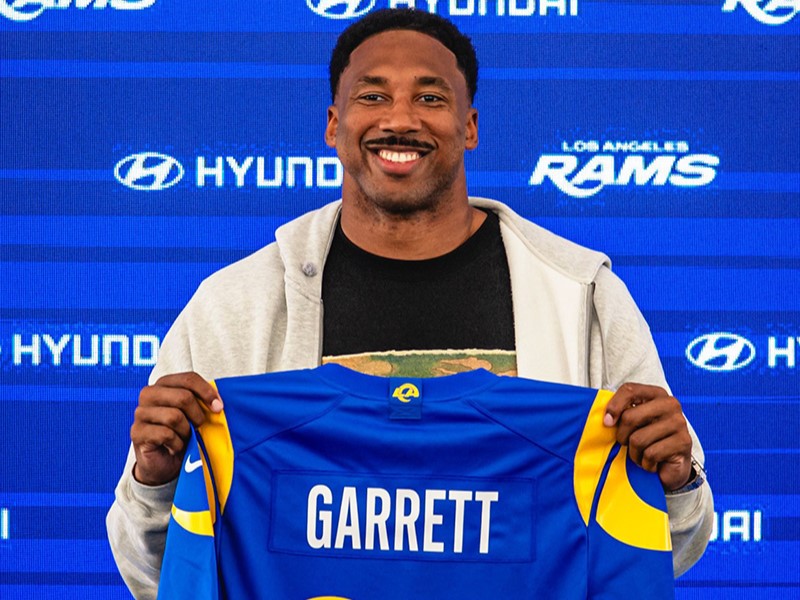
The Los Angeles Rams have made one of the most significant moves of the post-June 1 period by acquiring Myles Garrett, adding a player widely regarded as one of the league’s most dominant defensive forces. To complete the deal, the Rams sent edge rusher Jared Verse, a 2027 first-round pick, a 2028 second-round pick, and a 2029 third-round pick away.
The transaction signals another aggressive push from Los Angeles, which is betting that Garrett’s impact can elevate a defense that already performed well statistically but lacked a consistent game-changing presence in critical moments. With defensive coordinator Chris Shula now able to build around one of football’s premier pass rushers, the Rams are aiming to transform an already solid unit into one capable of deciding games on its own.
A proven game-changer joins Los Angeles
The Rams’ defense delivered strong results in 2025, finishing tied for seventh in defensive EPA per play and fourth in pressure rate. Shula’s scheme consistently generated pressure and confusion for opposing offenses through simulated pressures and creative rush designs.
Despite those strengths, Los Angeles struggled to produce decisive defensive plays when games were on the line. The addition of Garrett directly addresses that issue. Coming off a record-setting 23-sack campaign, he arrives as a defender capable of creating disruption without relying on scheme or support from teammates.
Although Verse is younger and regarded as a highly talented player, the Rams were willing to part with him because Garrett brings a different level of influence. His durability throughout most of his career and his ability to take over games made him worth the significant investment.
Instant pressure changes everything
One of the key reasons behind the trade can be found in Garrett’s ability to generate immediate pressure. According to NFL Pro data, he recorded 31 quick pressures in 2025, ranking fifth in the league. By comparison, Verse and Byron Young combined for 34 quick pressures over the entire season.
Los Angeles already possessed a productive front featuring Young, Kobie Turner, and Braden Fiske. However, those players generally won with similar power-based techniques that collapsed the pocket over time. Garrett offers something different — the ability to beat blockers almost instantly with speed and explosiveness off the edge.
That missing element affected the Rams’ overall production. While they regularly pressured quarterbacks, they converted only 18 percent of those pressures into sacks, placing them 21st in the NFL. Their Havoc Rate also ranked just 24th. Cleveland, powered by Garrett, led the league in both categories.
By adding a defender capable of creating negative plays on his own, Los Angeles expects to improve its efficiency and become far more dangerous in critical situations.
Creating opportunities for everyone else
Garrett’s value extends beyond his individual statistics. Over the last five seasons, he has led the NFL in quick pressures and regularly forces offenses to devote extra resources to slowing him down. In 2025, he faced more chip blocks than any other defender.
That constant attention has a ripple effect across the entire defense. Offensive lines must account for Garrett before every snap, often altering protection plans and opening opportunities elsewhere. For a coordinator like Shula, who already relies on creative pass-rush concepts, that added flexibility could unlock even more production from the rest of the defensive front.
The impact resembles that of a basketball superstar whose presence creates space for teammates. Whether through designed pressure packages or simple one-on-one matchups, Garrett’s ability to attract attention can generate favorable situations for everyone around him.
A more aggressive identity takes shape
The Garrett acquisition follows the arrivals of cornerbacks Trent McDuffie and Jaylen Watson, further revealing the direction Los Angeles wants to take defensively. Watson brings size and effectiveness in press coverage, while McDuffie offers versatility, awareness, and ball skills.
Together, those additions support a more aggressive approach. Strong coverage at the line of scrimmage allows the pass rush extra time to reach the quarterback, while Garrett’s presence encourages opposing offenses to release the ball quickly.
Opponents averaged a time to throw of 2.77 seconds when Garrett was on the field in Cleveland, matching the fastest mark in the league. The Rams ranked seventh at 2.84 seconds, but the expectation is that Garrett can help drive that number even lower.
The combination of tight coverage, fast pressure, and Shula’s defensive design gives Los Angeles a blueprint for limiting explosive plays while forcing offenses into uncomfortable situations.
A defender who changes the equation
The move has drawn comparisons to the Packers’ acquisition of Micah Parsons a year earlier. Green Bay already possessed a quality defense before that trade, but Parsons provided a level of immediate disruption that altered how opponents attacked the unit.
Garrett is viewed in a similar light. Players of his caliber influence every offensive decision, forcing opponents to adjust protections, timing, and play design simply because they are on the field.
For the Rams, this trade is about more than adding another talented player. It is about acquiring a defender capable of redefining the identity of the entire unit. If Garrett delivers the impact Los Angeles expects, the cost of the deal could ultimately be justified by the results.