
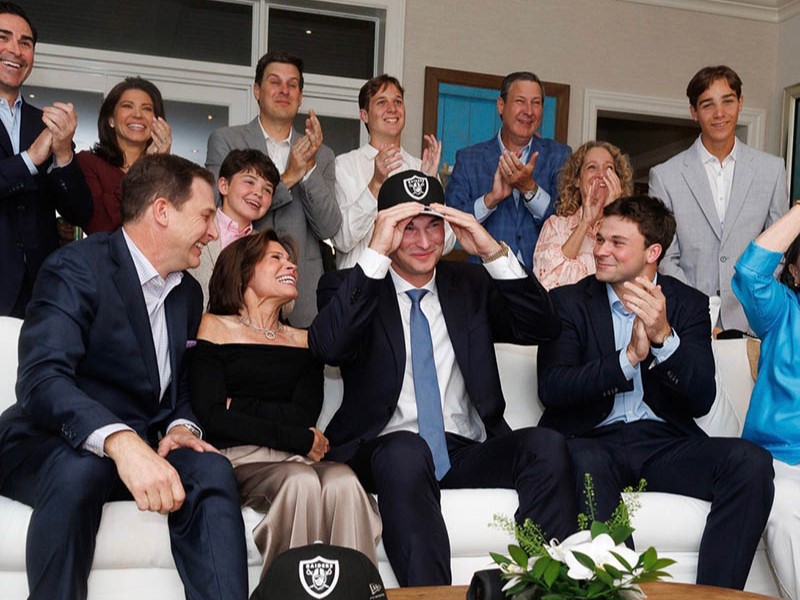
The Las Vegas Raiders have turned to Fernando Mendoza as the centerpiece of a long-awaited transformation, selecting him first overall in the 2026 NFL Draft. His rise has been remarkable: from receiving just one scholarship offer to completing a perfect 16-0 season at Indiana, capped by both a Heisman Trophy and a national championship. That rare combination places him in exclusive company among top draft picks.
Expectations could hardly be higher, especially given the organization he is joining. The Raiders have gone more than two decades without a playoff victory and have managed only two winning seasons in that stretch. For many fans, the franchise’s historic success feels distant, replaced by memories of painful losses and instability.
General manager John Spytek made it clear the goal is to avoid ever drafting first again. That ambition reflects both hope and urgency, as the team looks to reverse a prolonged period of underachievement. Mendoza arrives not just as a quarterback but as a potential turning point.
The weight of history, however, cannot be ignored. The Raiders’ struggles are deeply tied to years of poor roster building, and Mendoza’s arrival represents an attempt to finally correct that pattern.
Decades of missteps have shaped the Raiders’ identity
Few teams have struggled in the draft the way the Raiders have since 2000. By one statistical measure of player value, they rank last in the league over that span. The issues began with unconventional decisions, including using a first-round pick on a kicker and selecting a punter in the same draft.
The problems continued with a series of missed opportunities. Several first-round selections failed to meet expectations, while the players chosen immediately afterward went on to become some of the game’s greatest stars. This repeated pattern turned what could have been foundational moments into lasting regrets.
The most infamous example remains JaMarcus Russell, the team’s previous No. 1 overall pick, whose career never matched his potential. His struggles became symbolic of a broader inability to identify and develop talent. Meanwhile, later-round selections elsewhere in the league proved that success in the draft is far from guaranteed.
Compounding the issue was a philosophy that prioritized speed above all else during Al Davis’ later years. Numerous players were selected largely for their athletic testing results, yet none developed into standout performers for the franchise. The approach became a cautionary tale rather than a competitive advantage.
Instability and missed opportunities compound the problem
The Raiders’ challenges extend beyond individual picks. Over the past 23 years, the team has cycled through 14 head coaches and multiple general managers, creating a lack of continuity that has hindered long-term planning. No leadership group has been able to consistently build a competitive roster.
Even in more recent years, high draft capital has not translated into sustained success. A cluster of first-round selections between 2019 and 2021 largely failed to deliver, with only one player emerging as a reliable contributor. Several of those choices were widely viewed as reaches at the time.
Ironically, some of the franchise’s best draft successes have not remained with the team. Key players were traded during rebuilding phases, underscoring the difficulty of maintaining a strong core. Occasional bright spots have been overshadowed by the broader pattern of inconsistency.
The result is a franchise still searching for stability. Each draft has carried hope, but few have delivered meaningful progress. That context makes the selection of Mendoza even more significant.
Mendoza represents hope for a long-awaited turnaround
Despite the uncertainty that comes with any top pick, Mendoza offers reasons for optimism. His skill set, preparation, and leadership have drawn praise, and his playing style has been compared to established NFL quarterbacks known for intelligence and accuracy.
He enters a system that has previously supported similar players, and he will have access to mentorship from one of the game’s most accomplished figures. His dedication is evident in his preparation, including extensive film study and efforts to refine aspects of his game that will be critical at the professional level.
There are, however, adjustments ahead. His college offense relied heavily on shotgun formations, while his new team uses a more varied approach. Adapting to these differences will be an important step in his transition to the NFL.
Ultimately, the Raiders understand there are no guarantees. Past experiences have shown that even the most promising prospects can fall short. Still, Mendoza’s arrival offers a chance to rewrite the narrative. If he succeeds, years of disappointment could quickly become part of a larger story of renewal.