
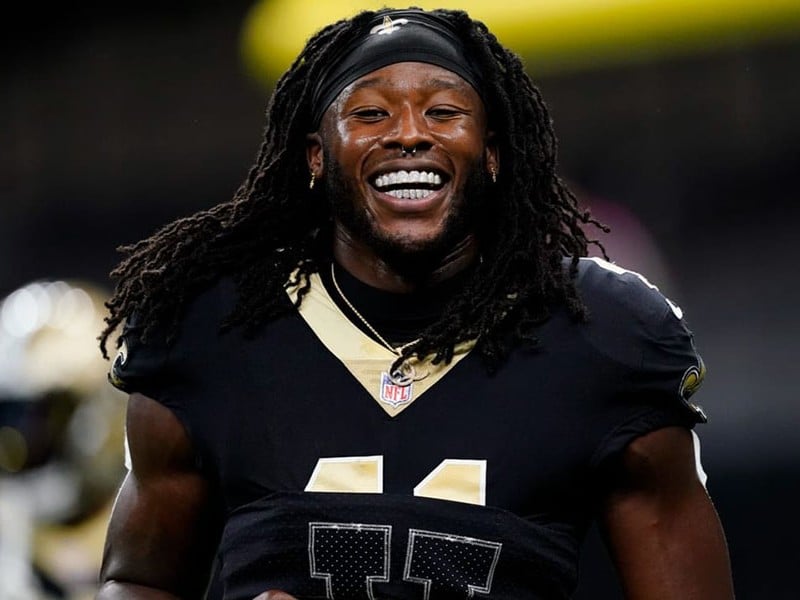
Alvin Kamara has spent all nine of his NFL seasons in New Orleans, and based on his recent comments, he still sees himself wearing a Saints uniform in 2026. Speaking on “The Set” podcast with Terron Armstead, Kamara addressed the team’s decision to bring in Travis Etienne Jr. and made it clear he is not viewing the move as a threat to his role.
Rather than expressing frustration, Kamara praised Etienne’s talent, pointing to his explosiveness and production over the past few years. He said he is eager to see what they can accomplish together, strongly suggesting he wants to remain part of the Saints’ plans despite immediate speculation about his future.
Kamara also dismissed any idea of tension between the two running backs. He explained that he was genuinely happy to see Etienne earn a lucrative contract and described the addition as valuable support in the backfield. In his view, having another high-level player alongside him only strengthens the team.
Although Kamara has not spent much time with Etienne this offseason, he said he is looking forward to building that partnership. His comments reflected enthusiasm for the pairing and reinforced that retirement or a desire to leave New Orleans does not currently appear to be on his mind.
Aiming to recreate past backfield success
Kamara’s optimism about Etienne is rooted partly in his own history. During his first two seasons with the Saints, he and Mark Ingram formed one of the NFL’s most productive rushing tandems, setting a high standard for shared backfield success.
He referenced that earlier partnership while discussing Etienne, noting that he and Ingram established a model for efficiency. Kamara suggested that while duplicating those exact results may be difficult, he believes the new duo should strive to approach that level.
In 2017, Kamara and Ingram combined for more than 3,000 yards from scrimmage, with Kamara producing both as a runner and receiver on his way to Offensive Rookie of the Year honors. That season remains a benchmark for what a balanced Saints rushing attack can look like.
Kamara’s remarks indicate he is fully open to adapting his role if New Orleans chooses a shared approach. Instead of resisting change, he appears focused on maximizing whatever structure gives the Saints the best chance to succeed.
Saints’ offseason decisions raise major questions
Despite Kamara’s public support for staying, New Orleans’ actions since March have created legitimate uncertainty. The first major signal came when the Saints restructured his contract less than 18 months after giving him a two-year extension.
By converting Kamara’s 2026 base salary into a signing bonus, the team created more than $8 million in cap space. While the move lowered his immediate cap hit, it also made a post-June 1 release or trade financially easier for the franchise without offering Kamara additional guaranteed money.
That restructuring was followed quickly by the signing of Etienne to a four-year, $48 million contract. Investing that heavily in another running back immediately fueled questions about whether New Orleans is planning for a transition away from Kamara.
With both players earning top-tier money at the same position, the Saints now face an unusual financial setup. The situation has prompted speculation that Kamara could eventually be asked to accept reduced pay, become part of a trade, or even be released.
Loomis’ cautious comments add to speculation
Saints general manager Mickey Loomis did little to quiet those concerns when questioned publicly about Kamara’s future. During an April interview on SiriusXM’s Mad Dog Sports Radio, Loomis avoided giving a direct answer about whether Kamara would remain with the team.
Instead, Loomis said the organization was still evaluating its roster and preferred not to discuss specifics. He used similarly guarded language when asked whether the Saints and Kamara were aligned or whether trade conversations were happening behind the scenes.
His reluctance to offer reassurance stood out, especially given Kamara’s clear statements that he wants to stay. The vague responses only intensified the sense that New Orleans may still be weighing multiple paths forward.
As a result, June 1 looms as a pivotal date because it marks the point when moving Kamara becomes far more manageable financially. Whether that leads to a revised agreement, a trade, or a release may ultimately depend on how committed both sides are to continuing together.
Retirement talk could complicate any trade scenario
One additional factor hanging over Kamara’s future is his previous stance on playing elsewhere. Before the 2025 trade deadline, Kamara said he did not want to leave New Orleans and suggested he would rather walk away from football than suit up for another franchise.
That position could significantly impact his market if the Saints explore trade possibilities. Teams may hesitate to offer meaningful compensation if there is concern Kamara would choose retirement instead of relocation.
For New Orleans, that possibility could reduce leverage and make a straightforward release more realistic if the franchise truly decides to move on. At the same time, Kamara’s continued desire to stay leaves open the possibility that both sides could still find common ground.
For now, Kamara sounds committed to the Saints, but the organization’s financial moves and public messaging suggest his long-term place in New Orleans is far from guaranteed.